Showing posts with label bald eagle. Show all posts

November 17, 2014

Animal Facts: Bald Eagle

Haliaeetus leucocephalus

Kingdom: Animalia
Phylum: Chordata
Class: Aves
Order: Falconiformes
Family: Accitridae
Genus: Haliaeetus
Species: H. leucocephalus

Fast Facts
Lifespan: typically up to 10 years in the wild (banding record 30 years 9 months)
Size: 6-7.5 foot wingspan; weight: 8-14 pounds; 30-37 inches tall
Eggs Laid: 1-3 eggs
Flight Speed: 35-40 mph
Status: Threatened in New Hampshire

What are tips for recognizing a Bald Eagle in the wild?
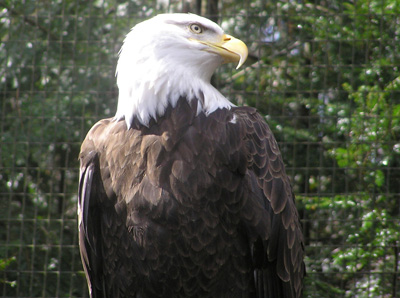
Adults are relatively easy to spot with white heads and tails, brownish to black bodies and bright yellow eyes, bill and feet. If you see a pair, the larger one is always the female! Immature Bald Eagles are well camouflaged with dark brown head, tail and body as well as white blotches on the underside of the wings. Young eagles don’t molt into adult plumage until four or five years of age. When soaring, Bald Eagles hold their wings level with their body (rather than the upward tilt of the Turkey Vulture). Their call is a squealing cackle, similar to a gull.

Where are Bald Eagles found?
Bald Eagles range only in North America, with the largest population in Alaska.

What do Bald Eagles eat?
Their prey is primarily fish, although Bald Eagles will feed on muskrats, squirrels, rabbits, waterfowl and carrion. Sometimes they will pursue and steal fish from Osprey.

What about nesting behavior and raising young?
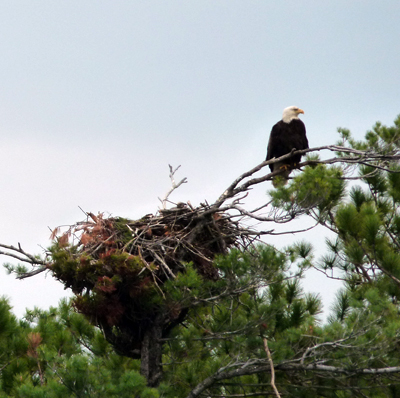
Bald Eagles become sexually mature at four or five years of age and breed from March until May. Both male and female build the nest and add new nesting material to last year’s nest every spring. Nests are used perennially. Nests are usually built in treetops and can be seven to eight feet across, constructed of sticks with a lining of soft materials like grasses or moss. Two and sometimes 3 eggs are laid a few days apart in March to May, with an incubation period of about 35 days. If food supply is limited the chicks compete with each other and the strongest, usually the oldest, survive. In approximately 72 to 75 days the chicks fledge (take their first flight).

Fun Facts!
  • The name “bald” comes from the Middle English word, “balled,” meaning “shining white.”
  • The Eagle’s scientific name, Haliaeetus leuocephalus, means “sea eagle with white head.”
  • In 1787 the Bald Eagle was officially adopted as our national symbol.
  • In 1976 the Bald Eagle was put on the endangered species list, mainly due to problems with the pesticide, DDT which caused thin egg shells.
  • By 2007, recovery was successful enough to remove the Bald Eagle from the federal endangered and threatened species list. Still listed as threatened on the NH state endangered and threatened species list.

May 15, 2014

Eagles Hatch... and Merlin encounter

Executive Director Iain MacLeod confirmed that the Bald Eagle pair on Squam Lake has successfully hatched at least one chick this year. This is exciting news, after last year’s failure. Many of you will recall that in April 2013 during a 24-hour long ice storm, the eagle pair were forced to give up incubation just a couple weeks short of hatching. This year, the eagles built a new nest in a large pine tree on the north edge of Long Island. They got a later start than usual, but were incubating eggs by April 1. Iain watched from Deephaven Point (thanks RDC for access) with his powerful spotting scope and confirmed that the female eagle was feeding at least one eaglet. It’s possible there are more chicks, but only one little white head was visible.

While watching, Iain was also able to make observations on the local pair of nesting Merlins. For the last several years, at least one pair of Merlins has nested on the Rockywold Camp property. The male Merlin perched near Iain allowing him to snap this photo on his phone through his scope. Shortly after the photo was taken, the male flew down to the rocks on the shore of the lake and recovered a cached prey item (a male Cape May Warbler), which he quickly plucked, partially-consumed and then brought to the female who was sitting on their nest nearby.

May 27, 2013

Squam Lake Eagles

By Iain Macleod

The pair of Bald Eagles that nest on Squam Lake have a little more time on their hands (wings?) this year, although not by choice. Sadly our pair’s nesting attempt failed during that awful day-long ice storm on April 12. The pair had refurbished their usual nest on Little Loon Island during the late winter and I first observed them sitting low in the nest (indicating that eggs had been laid) on March 20. Their nest is very open to the elements and I assume that the accumulating ice on her feathers forced the female to abandon the nest on April 12. On the 13th both adults were near the nest and the female tried incubating briefly but was clearly disturbed and quickly left. By the 15th, both were perched well away from the nest indicating that the eggs were no longer viable. The loss was too far into their breeding cycle for them to start over, so for 2013 there will be no chicks in the nest. The pair will remain around the lake defending their territory and may even visit the nest occasionally.

This pair of Bald Eagles first nested on Squam in 2003. Since then they have raised 18 chicks, including two broods of 3 chicks in 2011 and 2012. The male’s leg bands indicate that he was hatched in a nest at Quabbin Reservoir in Massachusetts in 1997, so is 15 years old. His mate’s leg bands indicate that she too was hatched at Quabbin (in a different nest) in 1999, so she is 13 years old.

When this pair started nesting at Squam, they were the first pair of eagles to do so in the Lakes Region in living memory. Now there are more than twelve pairs of eagles in the Lakes Region and more than 30 in the state. We assume that many of the 18 chicks that this pair has produced have returned and settled in the state. This was proved last year when an adult eagle breeding at a newly discovered nest on Lake Winnipesaukee in Alton was identified by its leg band as “Black 6/N.” That band was placed on the leg of a chick in the Squam nest on June 3, 2005 – the only chick ever banded at the Squam nest.

So, 2013 is an off year for our highly productive eagle pair, but, all else being well, they will breed again next year and continue to help repopulate the state with healthy eagle chicks.

January 14, 2013

Why do bald eagles have yellow beaks?


By Senior Naturalist Dave Erler

Not long ago a Squam Lakes Natural Science Center trail visitor observed the immature and adult Bald Eagles housed at the Raptor Exhibit and asked me a great question. Why does the adult Bald Eagle have a yellow beak? I pondered for a moment before responding. I recollected from the ornithology course I took in college that the outer covering of a bird’s beak was composed of keratin, which is similar to keratin in mammal nails or claws, reptile scales, and bird feathers. I also explained that the yellow color in bird beaks, ceres (the fleshy portion at the base of a raptor’s beak), and feet are caused by pigments called carotenoids. After sharing this information, I explained that when I first came to work at the Science Center some three decades ago, most of the raptors in our collection had very dull color in their ceres and feet. This prompted me to contact a veterinarian I knew who worked with raptors. The vet explained to me that the carotenoids in bird beaks have a slightly different composition of proteins and glycine than is found in other animals. The yellow color is influenced by both diet and hormones. The vet suspected the dull color was the result of a vitamin deficiency, possibly vitamin E. On the vet’s recommendation we began to use a vitamin supplement formulated for hawks and falcons. After a few months, there was a marked improvement of the birds’ ceres and feet, indicated by a brighter yellow color.
After sharing all this information with this gentleman, I could tell by his glassed-over eyes that I had missed the intention of his question. So I asked him if his question was really, “What is the function of having a yellow beak?”  He nodded yes. Realizing I had already bored him senseless, I simply stated it probably indicates to other eagles that the individual is fully mature and healthy, important factors if you are trying attract a mate and hold a territory. That answer was sufficient and he wandered off leaving me to wonder why I don’t have a yellow beak.