Showing posts with label Squam Lakes Natural Science Center. Show all posts

April 2, 2018

What is this squirrel doing?

By Eric D'Aleo

Gray squirrels are ubiquitous and sometimes downright annoying to homeowners. Raiding birdfeeders, chewing on siding, or getting into an attic, give these tree-loving rodents some bad publicity. Aside from frustrating humans, squirrels are intelligent, curious, resourceful, and have some interesting behaviors. One common behavior is their seasonal hoarding or burying of nuts and seeds. This allows squirrels to survive through winter, since they feed on nuts hidden earlier in the year. Look at the video below and notice this industrious behavior occurs from spring through fall. Bu watch carefully, squirrels may sometimes fake bury a nut to fool other squirrels or birds from locating the food.

Along with storing food to eat at a later time, squirrels are interesting to watch feed. They eat a variety of food items, including nuts, seeds, fruit, mushrooms (fungi), tree buds, an occasional insect, and even bird nestlings. However, the majority of their food is nuts. What two food items can you see the squirrel eating in the video below?

Some behaviors squirrels engage in leave us scratching our heads in wonder. Take a look at the final video and see if you can determine what the gray squirrel is doing.

Squirrels are territorial animals and mark their territories to let other squirrels know an area is “occupied.” This behavior benefits both the intruding animal and the resident squirrel as it sets a boundary and reduces potential conflict. Squirrels mark areas in their territories by urinating on objects or by rubbing scent on logs or other objects from glands located near the mouth. Squirrels may also mark their territory by gnawing vertical strips in a large tree to provide a visual and olfactory cue to other squirrels in the area.

These are only three squirrel behaviors caught by the trail cameras, but many of us see squirrels engaging in other behaviors around bird feeders, scolding predators from a tree, or chasing each other through the branches. Who knew that squirrels led such busy lives?

March 26, 2018

Stories to Tell – Winter Clues

By Eric D'Aleo

Each trip outside to check the trail cameras is an adventure because I don’t know what I will find. Most of the time it is routine with the unexpected being the images captured by the cameras, but that is not always the case. Sometimes scat is left behind and the identification mystery begins. Questions run through my mind as I study the scat on the ground. Is the scat in a prominent location, such as a rock, log, or in the middle of a trail? How large is it and what is its shape? Are there any food items identifiable in the scat? Scat is found throughout the year, but for tracks, winter is the best time of year to look for them. I see many tracks as I move from one camera location to another. Sometimes they are fresh and easy to identify and other times they may be days or weeks old, making identification more challenging. Again, I run through a series of questions to help me identify the tracks. What’s the size of the track? How many toes are visible? How is the animal moving? Is it walking, bounding, or hopping? Where are the tracks located? Are they in a forest, in a field, or in a wetland? Do the tracks lead to a tree, a brush pile, or a burrow? The answers to these questions may provide a clue as to what animal made the tracks.

Look at the scat and tracks that were found during the past year and see what ones you can identify.


Occasionally, other unusual signs of an animal’s presence are discovered. Look at the photo below. What do you think was found on the snow this January? At the time of discovery, the snow had a hard crust and there were no foot-prints in the area. The location was near a trail camera, but was not in its line of view. When I checked the camera’s memory card I saw no evidence an animal had been in the area since the last time I had been there. The area is a mixture of conifers, mostly hemlock, and hardwood trees, beech, red maple, and oak. The object was not found near any tree. So, what was it?


The tail of a flying squirrel! My next question of course was what happened to the rest of the animal? This question was left unanswered since the hard snow crust offered no additional clues.

A similar experience happened in early March. Again, the body part from an animal was found on a hard snow crust with no animal tracks nearby. However, it was found in the snowbanks of a parking lot. Look at the photo below to identify what animal it came from.


It was the foreleg of a white-tailed deer. How had it died? Did it starve? Was it preyed upon? What animal brought the leg and left it here? Was it left there on purpose, was the amount of meat left on the leg too small to hold on to, or was the leg dropped to flee quickly from the area? More unanswered questions, but ones that keep me coming back for more, like a good mystery. What animal stories are waiting to be discovered where you live? Find out.

February 26, 2018

Stories to Tell - What Time is it Mr. Fox?

By Eric D'Aleo

The children at Blue Heron School play a game called What Time is it Mr. Fox? A child who is the Fox calls out a time (1 o'clock - 12 o'clock). The other children take that many steps toward the fox. When the group gets close to the fox, but not past him, and asks, “What time is it?” the fox yells, "Midnight," and turns and chases the group around to tag someone. The children enjoy the game and play it often.

Watching the children play got me wondering if our trail cameras could tell us anything about red fox activity throughout a year. It turns out, they can.

By looking at the information collected from each camera from January through December, red fox were photographed or videoed over 1,600 times. We plotted the number of sightings with the time each image was captured and graphed it. The results are in the charts below.

Red fox are most active early in the morning from midnight until five o’clock in the morning and in the evening from five o’clock till midnight. The highest activity occurs at three o’clock in the morning and six o’clock in the evening. Even though activity levels drop dramatically during daylight hours, and remains low, it’s still about sixteen percent of peak activity level. So unlike in the game where midnight is the time when Mr. Fox comes out to hunt, seven o’clock at night is more accurate. The data collected here at the Science Center corroborates research defining red fox as crepuscular, active at dawn and dusk, or nocturnal, active at night. But what about monthly activity during the year, are there some months with higher activity than others?

It appears there is one time of year when the sightings peak, which is early spring. This is when red fox raise

their young. One camera was positioned near a fox den. We saw the first sightings of the pups outside the den, early in April at night. When they were young, the pups required parental supervision. An adult red fox watched over them while they ran around, played together, and investigated their surroundings. As I reviewed video footage I was reminded of a human parent watching their children play at a playground. The camera also recorded evidence of the parents bringing food to their offspring and scenes of pups fighting over feathers and woodchuck fur. As the year progressed into summer the young foxes were still around and sighted by the camera, but less often. They may have been learning how to hunt from their parents or accompanying them as they patrolled their territory. There was no need for them to return to the den on a regular basis. By autumn the sightings declined suggesting the breakup of the family and the dispersal of the pups in search of their own territories.

What I find interesting is that this information leads to asking other questions about red fox on Science Center property. Do they have a preference for a particular natural community (field or forest)? Do they use a community more at one time of the year than at another time? What other species in the area are active at the same time of day? Are they most active at the same time of the year? Do they have the same habitat preferences? Answers to these questions may be found on line or in a library, but carrying out these observations on our property gives us a better understanding of what is happening locally. It helps us better appreciate of the land and provides an understanding of the requirements and habits of the animals living here. This information can be helpful to landowners considering how changes to a piece of property will affect local wildlife. What time is it for the animals where you live?

February 12, 2018

Stories to Tell - Bear curiosity or Bear destruction?

By Eric D'Aleo

It was the day before Halloween and the sky was gray and overcast. The area had just received a heavy storm that deposited over five inches of rain in twenty-four hours. Strong wind accompanied the rain and its remnants were still howling among the tree branches as I walked through the woods to check on some remote trail cameras. The streams were full with water and many trees in the forest had blown down, some across the trails. I discovered the trees were not the only things damaged. There had been a different kind of recurring “storm” in one location. I walked off the trail through the brush toward it. My destination was a vernal pool in a remote area of Science Center property. An unusual story had unfolded here earlier in the year involving a chicken carcass and a coyote. I had placed the chicken carcass out as bait and captured some interesting pictures over several weeks. This time nothing had been put out to draw an animal to the area, or so I thought. As I pushed through a stand of young hemlock trees I could see the rain had filled the vernal pool half full of water. I walked to the tree where the trail camera was and came to a halt. Something was wrong. The clasp to shut the camera had been opened and the batteries removed! My first thought was that someone had walked through the woods and vandalized the camera, an idea I quickly discarded. Most people photographed by the trail cameras are unaware of them or simply wave and say “hello” once they realize it’s there. I closed the camera and found my first clue; the motion detector’s plastic covering was punctured.
The second clue lay around my feet. My feet disturbed the leaves just enough to revel the batteries. I searched through the leaves and debris and found all of them. They were dirty but otherwise fine. I had unknowingly received an additional clue weeks earlier when the same camera was found on the ground and the strap that held it around the tree was found twelve feet away. That time the culprit was a black bear.

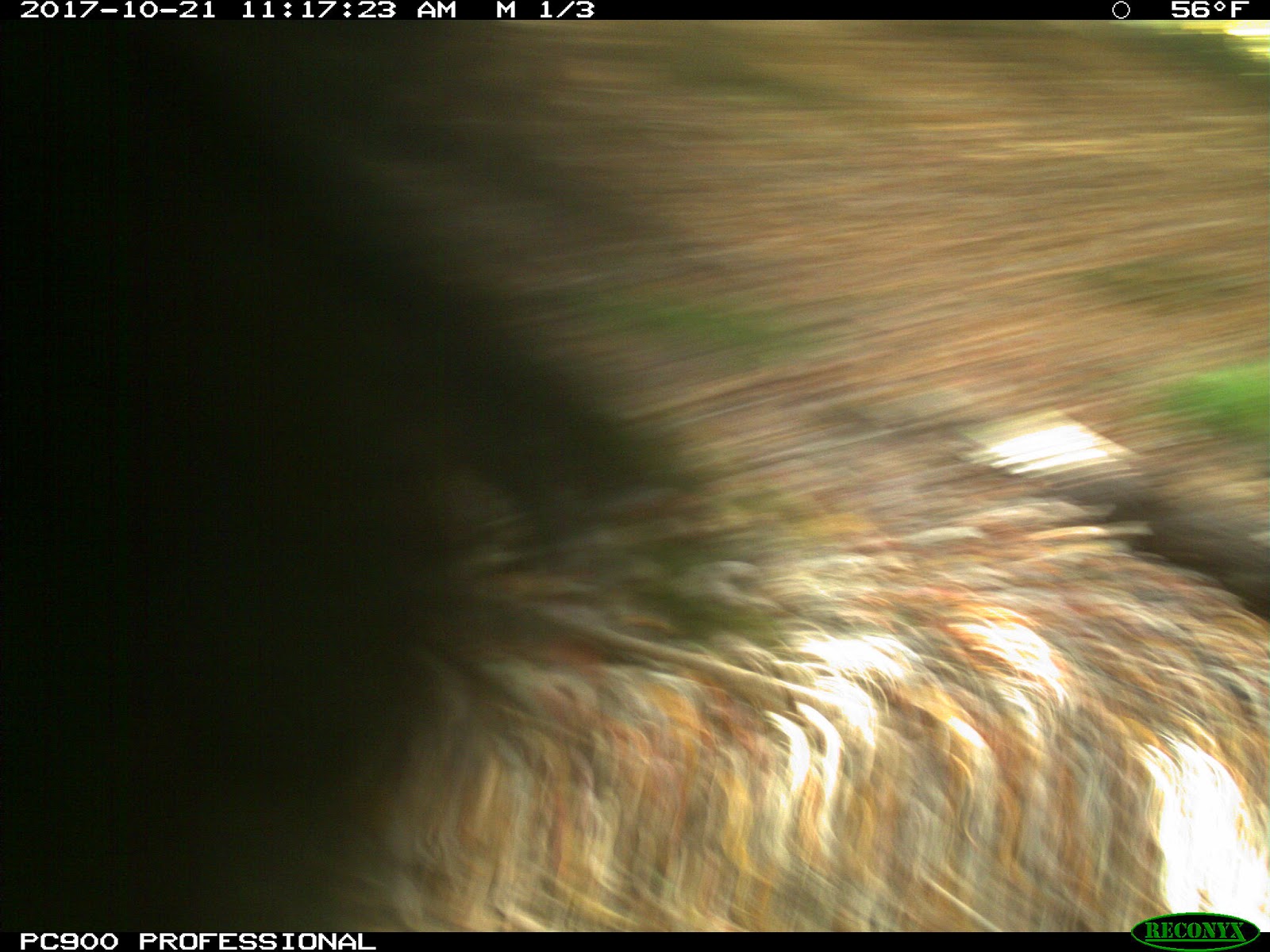
I experienced déjà vu as I stood looking at the camera on the ground and the batteries in my hand. I thought a black bear might also be responsible for the damage this time. I took the broken camera to my office and looked at the images. Sure enough, it showed a black bear yearling energetically investigating the camera. Black bears are curious and investigate novel objects. Apparently the camera interested this bear. It flashes an infrared light whenever there is nearby movement and takes a picture. Perhaps it might rouse a bear’s curiosity to investigate but the yearlings and their mother hadn’t showed much interest in the camera before September. When I looked through the images, this bear was intent on the camera and moved it back and forth triggering the camera to take distorted images of the ground, its fur, its face, its mother, and its sibling from numerous angles.

This young bear was investigating a novel object by smelling it, “manipulating” it with its paws, and finally by trying to chew on it. I thought the bear would lose interest after its first camera encounter. But how wrong I was. This behavior happened again four times during one week in October. Each time the bear would paw and wrestle with the camera anchored to the tree. The last day of images was October 21. The bear must have accidentally triggered the camera latch to open. Once opened it was only a matter of time before the yearling pawed the batteries loose causing the camera to stop taking pictures. There were no pictures of a bear’s mouth or teeth, but the puncture mark in motion sensor covering must have been another way it examined and “tested” the camera. I thought the camera could be sent off for repairs and wondered if I would have to stop gathering images from that location. I was more than just curious now. I was also feeling a bit stubborn about keeping a camera at the vernal pool. I moved a camera from a different location to the study area, but enclosed it in a protective metal case and secured it to the tree with a sturdy wire cable. Maybe this might prevent the black bears from becoming too zealous in investigating the camera and I could learn what might happen before they denned for the winter. We’ll see what the future brings.

January 29, 2018

Stories to Tell - Late Night Swim

By Eric D'Aleo

Have you ever taken a late night swim? Maybe the sweltering summer heat was so bad one night that it was the only way you could cool off and get a good night’s sleep. Maybe you forgot to bring a bathing suit and went swimming in your skivvies or au naturel, grateful for the cloak of darkness. But what would you think about swimming in a New Hampshire pond on a late April night? Not enticing? Apparently it is to a black bear, because that is exactly what happened in a vernal pool on Science Center property.

The air temperature that night was 57 degrees Fahrenheit, not exactly warm, but the water must have been colder. Twelve days before the image was taken, the surface of the vernal pool was frozen, so it was probably a cold, but invigorating swim. The images show the black bear leisurely swimming around as if a cold late night bath was a routine event. I was surprised to see when I looked at the images how much the vernal pool’s depth had changed from September to April. Most vernal pools are quite shallow, ranging from several inches to a foot deep. Yet this pool was quite deep. In September the ground was completely dry. Over the winter it filled with snow and then with spring rains so that by April the pool was about four feet deep. The bear left after a few minutes, perhaps in search of food or other reasons only it knew.

Besides being a spa for bruins, vernal pools serve as important habitat for a variety of wildlife. White- tailed deer, raccoon, bobcat, red fox, grey fox, and a barred owl have been spotted by the trail camera. A number of smaller animals the camera has not seen use this vernal pool as well. Amphibians such as spotted salamanders and wood frogs breed and raise their young in these temporary water bodies each year. Invertebrates, like fairy shrimp, caddisflies, and mosquitoes also use vernal pools to live part of or their entire existence here. Each of these animals is in a race against time before the pool dries up. Amphibians need to grow and undergo metamorphosis to finish their development to survive the transition to land before the pool dries up. They will return to the same location as adults to breed each spring. The fairy shrimp operate on an even faster schedule. They complete their development in forty days, breed, lay their eggs, and die before the pool dries up. Their eggs will survive without water until the following spring, when the pool fills up, and the bruin and the shrimp share the water once more.

September 18, 2017

The soft hues of fall (maple leaf viburnum and hobble bush)

By Eric D'Aleo, Naturalist

Walk through any forest in the northeast in the fall and you are sure to be struck by the brilliance of the colors of the foliage. Many visitors to New Hampshire look forward to mountain ranges robed in various shades of bright colors or search for scarlet-leafed maples along the back roads of small towns. When people walk the trails throughout the state their gaze is often pulled skyward to look at the gold of the aspens and birches, the orange of the oaks, and the red of the maples. However, do not forget to search beneath the brilliant colored canopy for the softer and more subtle hues of the season.

The maple leafed viburnum is a shrub often mistaken for a young red maple tree because its leaves have a similar appearance. A mature plant may reach a height of three to six feet and is often found in the shade of upland forests consisting mainly of beech and maple. In the fall this shrub’s foliage comes in various pastel shades of pale yellow, light pink or a deeper rose color. Often these colors are on several leaves of the same plant or all on the same leaf. The fruit turns a dark blue and is eaten by turkeys, robins, cedar waxwings, flickers, bluebirds, cardinals, flycatchers, thrashers, thrushes, and woodpeckers. In the spring and summer the leaves are a larval food source for the spring azure butterfly and the flowers are a nectar source for the golden-banded skipper.
Maple leaf viburnum
flickr/Katja Shultz
Another understory shrub often overlooked until it “trips” you is hobble bush. Also known as witches hobble the plant is found in rich, moist, wooded areas. The shrub can grow to a height of six to twelve feet and has the ability to root when a branch bends down and touches the ground. This creates dense thickets of plants that make traveling through them difficult. Tripping hazard aside, the shrub’s leaves turn a burgundy to dark plum color in the fall. If the central portion of the leaf still remains green it reminds me of a sliced kiwi whose colors are reversed. The berries also ripen in the fall, changing color from red to dark blue and may be eaten by ruffed grouse, cedar waxwings, brown thrashers, squirrels, and chipmunks. So don’t overlook these lesser known fall color artists, look for their softer hues hidden in the forest and you will be rewarded.
Hobble bush
flickr/US Fish & Wildlife Service

August 14, 2017

Fisher

Martes pennanti 
Kingdom: Animalia
Phylum: Chordata
Class: Mammalia
Order: Carnivora
Family: Mistelidae
Genus: Martes
Species: M. pennanti

Fast Facts:
Lifespan: 3-4 years in the wild
Size: 31-47 inches in length, weight 4.5-12 pounds
Offspring: 1-4 young
Status: Populations have recovered from extreme lows in early to mid-1900

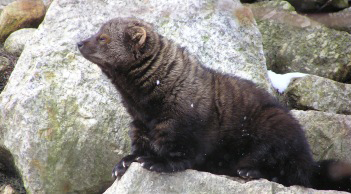
What do fishers look like and what animals are their relatives? Dark brown to black in color with a silver tinge to the head and shoulders, fishers are medium-sized mammals similar in size to a fox. Fur tends to be softer and darker in females. Short legs bring them close the ground and they bound with hind paws landing in the place of the front paws, leaving sets of two foot prints side by side. Male fishers average about 10 to 12 pounds but definite sexual dimorphism is evident, with females being a little over half the weight of males. Fishers are members of the family Mustelidae, with relatives being weasels, martin, mink and otters.

What kind of habitat do fishers favor? Fishers prefer continuous forest with a thick canopy, translating in the northeast to dense lowland coniferous forests or a mixed forest of conifers and hardwoods. In distribution, fishers are found in southern Canada, New England, New York state and several other northern states. Home range varies from a little over two to 15 square miles depending on the quality of the habitat.

What do fishers eat? Fisher prey upon snowshoe hare, squirrels, mice, and birds, but perhaps their most intriguing catch is the porcupine. Although not immune to porcupine quills, the fisher has a hunting technique that results in it getting few quills. Using agility to its advantage, the fisher circles the porcupine, looking for opportunities to bite at its unprotected face, while staying away from its powerful tail. Even if the porcupine tries to climb a tree, the arboreal fisher can climb above it and threaten it back to the ground. After about one-half hour, the porcupine may be weakened enough for the fisher to flip it over and attack the ventral side, which has no quills. Porcupine quills rarely cause infection in fishers and accidentally ingested quills often end up in fisher scat! Fishers will also eat carrion. It is unusual for a healthy adult fisher to become prey itself.

Fun Facts! 

  • Do fishers eat fish? Although they will readily eat fish, individuals rarely, if ever catch them. In his comprehensive reference book, The Fisher, Roger A. Powell concludes that the best source of the name was early settlers who noted the similarities between the fisher and the European polecat. Other names for the polecat were fitch ferrets, fitchet, fitche and fitchew – not a big leap to the name “fisher.” 
  • In New England we commonly hear this animal being called a “fisher cat”, a confusing label since fishers are not in the cat family. 
  • Active day or night, fishers are more nocturnal in proximity to people. 
  • What about those screams in the night? Those loud calls are probably porcupines or perhaps owls or foxes rather than fishers. 
  • Now, what about fishers being responsible for the disappearance of domestic cats? Fishers can prey upon cats, but Great Horned Owls, coyotes and cars take a more significant toll. Keeping cats in at night is a good solution.

July 31, 2017

2017 Breeding Bird Census Results

Since 1977, Senior Naturalist Dave Erler has conducted a census in early June of bird species that nest on the Science Center campus. The census is done primarily by ear, listening for territorial songs of male birds, indicating probable nesting. The census gives us a snapshot of the bird population by doing the review on approximately the same date each year. This year we held the census on June 10.

The zones referred to below roughly correspond to: Zone 1 – 30 acres that make up the primary use areas (buildings, exhibits, fields etc.); Zone 2 - +/- 100 acres of forests partly logged for forest management in 2016; Zone 3 - +/- 100 acres of other managed forest area.

We saw a total of 46 individual species and 113 individual birds. See the full details of species and location.


May 10, 2017

Stories to Tell – Guess Who Came to Dinner?

By Eric D'Aleo, Naturalist

We’ve all experienced it. A fresh set of tracks in the snow. The first question you ask yourself is… Whose track is this? This leads to a number of other questions. Where did it come from? Where was it going? What happened here? These questions often remain unanswered unless we can track the animal, we have a camera in the location, and we’re lucky. This is one such occasion with an amazing answer.

It was a cold, late winter morning and a light snow was falling as I plodded through the woods. Occasionally my feet broke through the snow’s crust and I’d sink in up to my calves. “Not a day to skip wearing snowshoes,” I chided myself, but I was more than halfway to my destination. I was eager to check the final trail camera of the day and see what it had recorded over the past month.

I hiked over the last rise and saw the log where I had secured a chicken carcass in February. The location was 15 feet from the camera. I was surprised to find there was no sign of the chicken. It was completely gone. “What took it?” I wondered. I walked over and looked around. No visible signs of feathers or bones, although they might have been covered by the recent snow. The only clues were obscured footprints and marks in the snow I could not identify. It was obvious there had been recent activity but it seemed that the camera might be the only witness. The snow continued to fall as I changed the camera card and headed back to my office to upload the information to the computer.

Once at my desk, the story of the missing chicken and the disturbance in the snow played itself out on my computer screen. The first animals to investigate the chicken carcass were a pair of raccoons. They arrived at dawn two days after I had put the bird out. They sniffed and pawed at the feathers before one took some bites and claimed the chicken as its own. It stood on the frozen body keeping the other raccoon at a distance. This lasted for 30 minutes until they left, perhaps because the morning sun was too bright.

Twelve hours later the two raccoons returned. Again only one animal fed; apparently the larger one was dominant. The second raccoon circled and wandered just out of reach looking for an opportunity to find something to eat. This behavior lasted for an hour before they left. I found this surprising since the time stamp on the last image of the raccoons read 7:20 p.m. They should have had plenty of time for them to continue feeding. The next image held the answer. A coyote came into view 50 minutes later.

The coyote was interested in the chicken but hesitated because of the infrared flash from the trail camera. It paced back and forth and circled the area maintaining a distance of 10 to 25 feet from the bird but never came closer. Then the coyote suddenly left. I stopped advancing the images. This seemed strange. Why didn’t the coyote feed? It seemed rather odd but I had read that coyotes are cautious when exposed to a new or unfamiliar food situation. But what animal was responsible for the missing chicken?

The next images answered my question. Thirty minutes after the first coyote left a second coyote entered the area. This animal was much larger and more confident. It walked directly to the chicken and assessed the situation. In less than two minutes, it determined the camera was no threat, sniffed the chicken, and set to work. It made quick progress severing the chicken from the anchors holding it to the log. Forty five minutes after it arrived, the coyote carried its frozen prize off into the night. I was amazed at how quickly the coyote removed the bird. I was excited to have an answer. But as I looked at the image I realized I had only a partial answer. I now knew what had taken the chicken, but I had no idea what animal left all the tracks and marks in the snow when I checked on the camera. All the images up until this point occurred on ice and a small patch of snow under the logs. When I removed the camera card in the morning, the entire area was blanketed with snow except for the slowly filling tracks. I was so immersed in what was happening I forgot to consider the surroundings. I thought I had an answer to my original questions, but now I realized I had only half the story. So I continued looking through the images.

An hour after the large coyote left with the chicken, a smaller coyote cautiously approached and circled the site from a distance of 30 feet or more. I assumed that it was the first coyote as it seemed to be the same size and exhibited the same behavior as before. It continued in this manner for five minutes and then left. It returned an hour later but only for a minute before it left again.

Four hours later, at 6 am a barred owl landed among the feathery remains. It pecked at the ground for a moment or two and then departed into the early morning darkness. The entire visit took a little more than one minute.

It was now three days after the chicken was initially placed, according to the time stamp on the progression of images, but even though the bird was gone, the site continued to be visited over the next 18 days. Several coyotes, two raccoons, and a gray fox all looked to see if there were any remains worth eating, but all left shortly after arriving.

I paused realizing I still did not have an answer to my second question. How were the markings left in the snow? As I continued looking at the images I noticed snow had covered the ice three days prior. Then the day before I arrived to switch the camera cards the puzzle was solved. Early in the morning a coyote visited the site. It seemed nervous by the infrared flash of the camera but seemed intent on approaching the location where the chicken had been. The ground was covered by several new inches of snow and there were no obvious signs to draw the animal in. Yet the coyote continued to warily approach. I thought that this must be the same coyote that had showed up the first night. It spent 12 minutes trying to overcome its anxiety. The coyote paced back and forth, dug at the snow behind one of the logs, bounded to one side, went back to dig some more, bounded away again, dug a third time, backed away, bit a low hanging branch in displaced frustration, and dug again until it finally came up with a small scrap of food. It took a few steps away, fed, and went back to anxiously digging and backing away for several minutes longer before it eventually left.


I looked at the final camera image of me as I stood at the site, looked at the marks in the snow and wondered what had happened here over the past month. I had to smile at the image of myself as I sat at the computers. I had no idea then of what story the camera would reveal to me that day.

April 24, 2017

Tick Season Has Begun

Getting outdoors is something many in New England look forward to in those first beautiful days of spring. We enjoy the long awaited sunshine and warmer temperatures that we missed through the winter. However, spring also brings the dreaded tick season. When spending time outdoors during the warmer months there are several precautions you can take to avoid tick bites and safely enjoy your time outdoors.
  • Stay on trails outdoors; avoid areas of overgrown brush and tall grasses. (The Live Animal Exhibit trail at the Science Center is wide, so it makes it easy to avoid brushy and grassy areas. You are not at increased risk for tick exposure walking on our trails compared to any other natural area.) 
  • Wear light-colored clothing so ticks can be easily seen. 
  • Wear long pants, a long-sleeved shirt, closed toe shoes with socks, and a hat. Tuck your pants into your socks and your shirt into your pants. 
  • Check yourself, your children, and your pets often for ticks, shower after returning indoors.
  • Use insect repellent containing DEET or permethrin (always follow directions). 
  • After returning indoors, run clothes in the dryer on high heat to kill any ticks that may be on the clothing.
American dog tick (Dermacentor variabilis)
Wikimedia/ Jerry Kirkhart
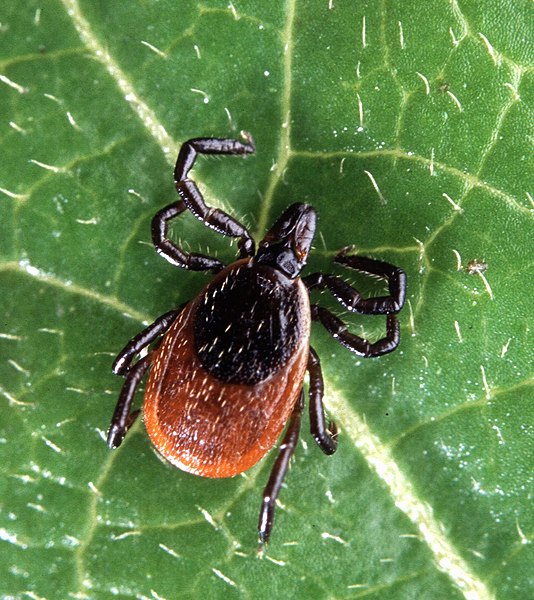
The Science Center sees a surge in the wood tick (also known as the American dog tick) population in spring, causing some concern among students, parents, and teachers. The good news is that by remaining on marked trails you run little risk of encountering ticks. Ticks cannot (and do not) jump off branches and shrubs. They instead cling to tall plants and wait for some creature to brush them off when walking by. Therefore, only students enrolled in off-trail programs are likely to find ticks. More good news!! Deer ticks (which are Lyme Disease carriers and are sometimes called black-legged ticks) are not typically found at the Science Center. If a careful body check is done within 24 hours of being outdoors and all ticks are removed, there is little cause for concern.

Black-legged tick (deer tick) - Ixodes scapularis
Wikimedia/USDA
Are wood ticks (American dog ticks) dangerous? The American Dog Tick has been known to
carry Rocky Mountain Spotted Fever and Tularemia. To transmit the disease to you, the tick has
to be biting you for over two hours. If you do a thorough body check when you get home there
is no need to worry.

How do I know if it is a wood tick or a deer tick? Not all ticks carry Lyme Disease. Deer ticks
are known to carry Lyme Disease but wood ticks are not. Wood ticks are quite a bit bigger than
deer ticks. Deer ticks are usually only the size of a head of a pin, while the wood tick can get to
the size of a small raisin when engorged with blood. If you are in doubt of what species of tick
you see, ask one of our naturalists!

Here are a few more helpful links:
Biology and Management of Ticks in New Hampshire - UNH Cooperative Extension
Tick Tips - UNH Cooperative Extension
Insect Repellents - UNH Cooperative Extension
https://www.cdc.gov/ticks/avoid/on_people.html https://www.dhhs.nh.gov/dphs/cdcs/lyme/documents/tickbites.pdf 

We're looking forward to seeing you on the trail this season!

April 10, 2017

Stories to Tell - Hello Kitty

By Eric D'Aleo, Naturalist

We’ve had a few sightings of a new visitor to the Science Center’s property over the past several months. A stealthy, elusive bobcat has been around but we were unaware of it. The first sighting that came from our trail cameras was last fall when a series of three photos were taken. It was late at night and the bobcat was walking through the brush, resulting in a blurry, black and white image, but it was definitely a bobcat!

This was exciting, since it was the first recorded image of the feline since we put up the cameras in January 2016. The second photo capture occurred in early December. The images were still blurry but they were in color! The animal had been out late in the afternoon in the same brushy ecotone area where it had been spotted earlier that fall. Once again, it was an exciting discovery but one that seemed unlikely to repeat itself. Then this past January, the cameras recorded a third sighting of a bobcat deep in the woods on our property.


The animal looked to be the same size as the animals in the previous photos, but there were no easily identifiable markings on its body to match it with the previous sightings. Again the sighting was during the day, late in the afternoon. Bobcats, it seems, are most active about three hours before sunset until about midnight and then just before dawn until three hours after sunrise. This fit the pattern of the animals in the photos. The animal was definitely on the move. I assume it was in search of prey. Our most recent camera record is from a March evening but from a different forest location. It seems our property may be part of a resident bobcat’s territory, which can range from 1 to 12 square miles. The size of the territory depends on food availability, the season, and if the animal is male or female. Male bobcats tend to have larger territories than females.


Our property and the surrounding area provide habitat a bobcat uses with brushy areas, old fields, forests, rocky areas, and wetlands. It will be interesting to see if the animal(s) continue to visit during spring and summer or only show up in the colder months. We will have to wait and see.

April 3, 2017

The lesser known New Hampshire heralds of spring

By Eric D'Aleo

April proclaims the beginning of spring on the calendar but is not always evident here in New Hampshire. Although southern New England may have green shoots poking through the soil and the hint of warm temperatures, further north there may still be snow on the ground and ice on ponds and lakes. However, there are still signs of spring. One I look for is the return of two small diving ducks: the hooded merganser and the common goldeneye.

The hooded merganser is a small but striking duck. Males have high contrast markings of black and white on their head, back, and chest, a brown scalloping pattern along its sides, a bright golden eye, and a slender black bill. Females are more subdued in their coloration, consisting mainly of browns and tans, with a red eye, and yellow bill similar in appearance to the male’s bill. Both males and females have a high crest on their head that looks like a Mohawk and can be raised and lowered at will. This species of duck prefers to feed in ponds and quiet waters of lakes and rivers. Once the ice opens up to reveal the water the mergansers return shortly afterwards. I have spotted them on the Squam River in Ashland during winter thaws only to disappear when it gets cold again and the ice reforms. Yet by March and April, the temperatures are warm enough to keep a permanent channel of water open, although the shoreline may still have ice. Then hooded mergansers are seen in pairs or small flocks as the males begin courting the females with their white, sail-like crests raised. Occasionally a male will make a low, gravely, groaning call advertising his fitness and interest in breeding. These small ducks also often dive beneath the surface in search for crayfish, aquatic insects, tadpoles, snails, and other mollusks on the river bottom.

Common Goldeneyes may also be seen briefly at this time as they pause on their spring migration north. The male has a black head with a white cheek spot next to its bill and a black back and tail. The chest and sides of the bird are white, while the female has a brown head with a gray body and wings. Both sexes have a bright yellow eye. These birds spend the winter along the New Hampshire coast and on large inland lakes or rivers where the water remains open. The goldeneye, like the hooded merganser, is a diving duck, using its back feet to propel it underwater. The diet of the goldeneye is similar to the hooded merganser, consisting of crayfish, mollusks, aquatic insects, and fish eggs on aquatic vegetation. Both species are very wary and best observed from a distance with binoculars.


March 27, 2017

Press Release: Squam Lakes Natural Science Center Celebrates Selection as Hannaford Cause Bag Program Beneficiary

Holderness, NH – Squam Lakes Natural Science Center has been selected as a beneficiary of the Hannaford Cause Bag program at the Meredith Hannaford during the month of April.

This exciting program has been designed to support local nonprofits like the Science Center. For every Hannaford Helps reusable bag with the good karma message purchased at the Hannaford located at Route 25 in Meredith, Squam Lakes Natural Science Center will receive a $1 donation in order to help fulfill its mission to advance understanding of ecology by exploring New Hampshire’s natural world.

“We are very excited to be chosen for the Hannaford Cause Bag program,” said Amanda Gillen, Marketing Manager at Squam Lakes Natural Science Center. “It’s a great way for people to do something small to help support the mission of the Science Center.”

Learn more about Squam Lakes Natural Science Center at nhnature.org. For more information on the Hannaford Cause Bag program, visit www.hannaford.bags4mycause.com or www.facebook.com/hhbagprogram.

About Squam Lakes Natural Science Center The mission of Squam Lakes Natural Science Center is to advance understanding of ecology by exploring New Hampshire's natural world. Through spectacular live animal exhibits, natural science education programs, an informal public garden, and lake cruises, the Science Center has educated and enlightened visitors since 1966 about the importance of our natural world. Squam Lakes Natural Science Center is located on Route 113 in Holderness, an easy drive from exit 24 off I-93, and is open daily from May 1 through November 1. The Science Center is accredited by the Association of Zoos and Aquariums (AZA) and is the only AZA-accredited institution in all of northern New England. For further information about the Science Center, call 603-968-7194 or visit www.nhnature.org.
###

March 23, 2017

Stories to Tell – Nature’s Scavengers

By Eric D'Aleo, Naturalist

One thing is certain; nothing ever goes to waste in nature. This seems especially true in the winter when food is scarce. Something that was once passed over by an animal when food was abundant may now be an important source of nutrition even if it is carrion. However, some wildlife never turns away from this free meal. These animals we call scavengers. When we think of scavengers several species may come to mind -- turkey vultures, carrion beetles, and fly larvae to name a few. However, many predatory animals may scavenge for food at some time during the year, particularly in winter. Here in New Hampshire scavengers may include fox, skunk, raccoon, opossum, bobcat, coyote, and eagles. Two additional birds often seen scavenging on Science Center property in the winter are ravens and crows. Both of these opportunists feed on a variety of food during the summer including fruit, grain, small invertebrates, bird eggs, nestlings, mice, and carrion. But during winter their diet is more limited and they scavenge more often.

Both ravens and crows have been seen scavenging through the Science Center's compost pile searching for food. They seem to prefer to visit the area at different times with the ravens most often seen earlier in the morning than the crows. When looking at images from the same location of the two birds it’s easier to see the difference in their physical appearance.

The raven is clearly larger than the crow and has a thicker, sturdier bill. The crow’s bill is more slender, which makes it more challenging for it to feed on carrion since it’s harder for it to puncture the skin of a dead animal, squirrel sized or larger. The raven’s bill, being larger and heavier, is better able to handle the force needed to feed on an animal carcass.

The raven has a shaggy ruff of feathers sometimes visible around its throat and on its legs that the crow does not have. This gives ravens a rougher and stockier appearance. There is also a difference between their tail feathers. A crow’s tail feathers are all the same length so that when they are spread it appears fan-shaped. A raven’s tail feathers are longer in the center of the tail than on the edges, giving its tail a wedge shape when the feathers are spread.
Both species are social, but ravens are most often seen in pairs while crows are more likely to be seen in family groups.
Look at the two images below and see if you can identify which bird is the crow and which one is the raven. Keep an eye out for these intelligent birds during the rest of the winter to observe their scavenging strategy for survival firsthand.


February 24, 2017

Volunteer Opportunities

Volunteering at the Science Center is enriching and fun. Learn something new and meet interesting people while sharing your talents and skills. Come explore with us and share your enthusiasm. We have a number of upcoming volunteer training opportunities. Learn more and see below for dates. For more information please contact Carol Raymond, Volunteer Manager, at 603-968-7194 x 22.

National Association of Interpreters Certified Interpretive Guide Training: April 6 through 9 from 8:00 a.m. to 5:00 p.m. daily
Interpreters are storytellers. They are tour guides, museum docents, zoo docents, park rangers, naturalists, and more. In this four-day course offered by the Science Center and National Association for Interpretation you will learn techniques to make connections with an audience, give meaningful and enjoyable presentations, and create thought provoking and relevant interpretive programs. Become a Certified Interpretive Guide through the National Association for Interpretation. Visit interpnet.com to register or contact Certified Interpretive Trainer Audrey Eisenhauer for more information.

Lake Education Assistant Training and Refresher: April 20 from 10:00 a.m. to 12:00 p.m.
Lake Education Assistants assist naturalists by leading lake testing activities aboard pontoon boats. Lake Education Assistants are at least 18 years old, enjoy boating in various types of weather, and leading educational activities. No prior experience is necessary. Lake Education Assistants are most active in May and June, and less so in July, August, September and October.

School Group Greeter Training and Refresher: April 25 from 10:00 to 11:30 a.m.
School Group Greeters are the first “face” school children see when arriving at the Science Center. Greeters board buses as they arrive, welcoming students, and helping them get started on their Science Center adventure. Greeters like to share a positive, welcoming demeanor, and their sense of organization. They are most active weekdays in May, June, September, and October. No prior experience is necessary.

Volunteer Instructor Training: April 27 from 10:00 a.m. to 3:00 p.m. 
Volunteer Instructors are trained to lead school groups in several ecology classes that include fun activities on site. The training on April 27 is an introduction to the classes. Trainees continue their instruction through observation and team teaching experiences before scheduling time to lead classes on their own. Volunteer Instructors are at least 18 years old and enjoy sharing knowledge and activities with school-aged children. No prior experience is required. Volunteer Instructors are most active weekdays in May and June, and less so in September and October. The training session is also open to previously trained Volunteer Instructors who would like attend as a refresher.

Water Matters Pavilion Host Training: May 1 from 10:00 to 11:00 a.m. 
Hosts are trained to introduce visitors to the exhibits in the Water Matters Pavilion. One exhibit – the Watershed Table – may be opened to visitors to shape and create digital “watersheds” in sand. Other exhibits include live animal displays, animal video cameras, and other interactive activities. Water Matter Pavilion Hosts match their schedules with available time slots. No prior experience is necessary.

Docent Training (for adults): June 19, 21, 21, 22 - 3:00 to 8:00 p.m.
Docents are volunteers trained to interact with guests on the live animal exhibit trail using educational props and live animals. Docents represent the Science Center at off-site events and also travel to assist naturalists with educational outreach programs. Docents must commit to 40 hours of training in their first year and 16 hours annually subsequently.
Cost: $50 (financial aid available) 

First Guides Training (for ages 14 to 17): June 28, 29, 30 - 10:00 a.m. to 4:00 p.m.
First Guides is a teen volunteer program based on our adult docent program. Teens learn how to be a welcoming and informative presence for visitors, often demonstrating animal artifacts alongside adult docent mentors with live animals.
Cost: $50 (financial aid available) 

January 31, 2017

Stories to Tell - November Rut

By Eric D'Aleo, Naturalist

It’s amazing how much animal activity there is in the woods during the fall. Many hunters are aware of the movement of animals at this time, especially white-tailed deer, as they get ready for winter. The deer are busy feeding on the remaining green foliage in November and acorns to put on as much body fat as possible. It’s exciting to watch the changes that have occurred over the past few months on our trail cameras. Gone are the deer’s red coats of summer covered over by dark brown guard hairs of their winter coat which help them survive the cold weather. Fawns that once had spotted coats have grown and lost all trace of their baby coloration. The most noticeable change in the deer are the male’s antlers which have lost the velvet appearance revealing hard bone underneath to advertise their fitness to does and other males. All in time for the white-tailed deer’s breeding season, also known as the rut.

There was a lot of deer activity on our trail cameras from October through November. Most of it occurred late at night but there were times during the day when deer were active. It seems that several does and their offspring continued to routinely visit different locations on our property like they had during the summer. Yet one location, a crossing of two well-travelled paths, seemed to be visited by them most often. There was also evidence of more males on our property this fall than over the summer. There may have been as many as five bucks moving throughout the property. Some of them were young with small antlers but two were large bucks who spent a lot of time roaming around the woods looking for a doe that was ready to breed. Occasionally there would be a close up view of an antler on our camera, either because a buck was interested in it or was possibly choosing to investigate a young tree or sapling nearby where it could take out aggression by rubbing its antlers on the trees. Take a look the photos below.

Notice the difference in the color of the fur in the summer and the fall.
Fall coloring
Summer coloring

Although the fawn is not the same distance from the camera in each photograph, notice the disappearance of the spots by the fall.


Here are images of two different bucks from the same location.  Can you tell which one is more likely to be the dominant male?


Here are the two bucks again at different locations but exhibiting the same behavior.  They are smelling the ground for evidence of a female that is ready to breed.


This location proved to be a good spot for the does and their offspring to visit throughout the summer and into the fall.


This image was taken in early December.  Now with the breeding season over, the long winter begins.  When more snow accumulates, this area will be abandoned for stands of conifers that provide more protection for the deer from the elements.

January 25, 2017

Volunteers Give Generously to Science Center

PRESS RELEASE:
FOR IMMEDIATE RELEASE – January 25, 2017

Holderness, NH – Each year volunteers at Squam Lakes Natural Science Center donate their time and energy to support an organization near and dear to their hearts. Volunteers help in various capacities and areas including education docents; development and marketing; special events; office; Kirkwood Gardens; volunteer instructor; educator assistant; greeters; animal care; exhibits and maintenance; and First Guides teen volunteer program.
Squam Lakes Natural Science Center announced a total of 354 volunteers donated over 8,700 hours of service to the Science Center in 2016. According to the Independent Sector, a nonprofit organization that calculates the value of volunteer hour state by state, the Science Center 2016 volunteer service hours have a monetary value of over $206,000 for the year.

Approximately 62 million American adults volunteer annually in some way, with nearly 8 billion hours of service. Volunteering at Squam Lakes Natural Science Center is personally rewarding but also offers benefits for the volunteer including monthly luncheons and educational programs, a gift shop discount, a membership discount, free trail admission on the days a volunteer is volunteering, use of the education library, volunteer newsletter, and an invitation to the annual Parsons Volunteer Recognition Dinner.

“We are so fortunate to have such an incredible group of volunteers supporting the Science Center,” said Carol Raymond, Volunteer Manager at Squam Lakes Natural Science Center. “There are so many wonderful stories and experiences that our volunteers provide for our visitors. We wouldn’t be the same organization today without our amazing volunteers.”

The Science Center offers Docent and First Guide teen volunteer training in June and July. Full details and dates will be available at nhnature.org.

To learn more about volunteering at Squam Lakes Natural Science Center please visit www.nhnature.org/who/volunteer.php.