Showing posts with label coyote. Show all posts

May 10, 2017

Stories to Tell – Guess Who Came to Dinner?

By Eric D'Aleo, Naturalist

We’ve all experienced it. A fresh set of tracks in the snow. The first question you ask yourself is… Whose track is this? This leads to a number of other questions. Where did it come from? Where was it going? What happened here? These questions often remain unanswered unless we can track the animal, we have a camera in the location, and we’re lucky. This is one such occasion with an amazing answer.

It was a cold, late winter morning and a light snow was falling as I plodded through the woods. Occasionally my feet broke through the snow’s crust and I’d sink in up to my calves. “Not a day to skip wearing snowshoes,” I chided myself, but I was more than halfway to my destination. I was eager to check the final trail camera of the day and see what it had recorded over the past month.

I hiked over the last rise and saw the log where I had secured a chicken carcass in February. The location was 15 feet from the camera. I was surprised to find there was no sign of the chicken. It was completely gone. “What took it?” I wondered. I walked over and looked around. No visible signs of feathers or bones, although they might have been covered by the recent snow. The only clues were obscured footprints and marks in the snow I could not identify. It was obvious there had been recent activity but it seemed that the camera might be the only witness. The snow continued to fall as I changed the camera card and headed back to my office to upload the information to the computer.

Once at my desk, the story of the missing chicken and the disturbance in the snow played itself out on my computer screen. The first animals to investigate the chicken carcass were a pair of raccoons. They arrived at dawn two days after I had put the bird out. They sniffed and pawed at the feathers before one took some bites and claimed the chicken as its own. It stood on the frozen body keeping the other raccoon at a distance. This lasted for 30 minutes until they left, perhaps because the morning sun was too bright.

Twelve hours later the two raccoons returned. Again only one animal fed; apparently the larger one was dominant. The second raccoon circled and wandered just out of reach looking for an opportunity to find something to eat. This behavior lasted for an hour before they left. I found this surprising since the time stamp on the last image of the raccoons read 7:20 p.m. They should have had plenty of time for them to continue feeding. The next image held the answer. A coyote came into view 50 minutes later.

The coyote was interested in the chicken but hesitated because of the infrared flash from the trail camera. It paced back and forth and circled the area maintaining a distance of 10 to 25 feet from the bird but never came closer. Then the coyote suddenly left. I stopped advancing the images. This seemed strange. Why didn’t the coyote feed? It seemed rather odd but I had read that coyotes are cautious when exposed to a new or unfamiliar food situation. But what animal was responsible for the missing chicken?

The next images answered my question. Thirty minutes after the first coyote left a second coyote entered the area. This animal was much larger and more confident. It walked directly to the chicken and assessed the situation. In less than two minutes, it determined the camera was no threat, sniffed the chicken, and set to work. It made quick progress severing the chicken from the anchors holding it to the log. Forty five minutes after it arrived, the coyote carried its frozen prize off into the night. I was amazed at how quickly the coyote removed the bird. I was excited to have an answer. But as I looked at the image I realized I had only a partial answer. I now knew what had taken the chicken, but I had no idea what animal left all the tracks and marks in the snow when I checked on the camera. All the images up until this point occurred on ice and a small patch of snow under the logs. When I removed the camera card in the morning, the entire area was blanketed with snow except for the slowly filling tracks. I was so immersed in what was happening I forgot to consider the surroundings. I thought I had an answer to my original questions, but now I realized I had only half the story. So I continued looking through the images.

An hour after the large coyote left with the chicken, a smaller coyote cautiously approached and circled the site from a distance of 30 feet or more. I assumed that it was the first coyote as it seemed to be the same size and exhibited the same behavior as before. It continued in this manner for five minutes and then left. It returned an hour later but only for a minute before it left again.

Four hours later, at 6 am a barred owl landed among the feathery remains. It pecked at the ground for a moment or two and then departed into the early morning darkness. The entire visit took a little more than one minute.

It was now three days after the chicken was initially placed, according to the time stamp on the progression of images, but even though the bird was gone, the site continued to be visited over the next 18 days. Several coyotes, two raccoons, and a gray fox all looked to see if there were any remains worth eating, but all left shortly after arriving.

I paused realizing I still did not have an answer to my second question. How were the markings left in the snow? As I continued looking at the images I noticed snow had covered the ice three days prior. Then the day before I arrived to switch the camera cards the puzzle was solved. Early in the morning a coyote visited the site. It seemed nervous by the infrared flash of the camera but seemed intent on approaching the location where the chicken had been. The ground was covered by several new inches of snow and there were no obvious signs to draw the animal in. Yet the coyote continued to warily approach. I thought that this must be the same coyote that had showed up the first night. It spent 12 minutes trying to overcome its anxiety. The coyote paced back and forth, dug at the snow behind one of the logs, bounded to one side, went back to dig some more, bounded away again, dug a third time, backed away, bit a low hanging branch in displaced frustration, and dug again until it finally came up with a small scrap of food. It took a few steps away, fed, and went back to anxiously digging and backing away for several minutes longer before it eventually left.


I looked at the final camera image of me as I stood at the site, looked at the marks in the snow and wondered what had happened here over the past month. I had to smile at the image of myself as I sat at the computers. I had no idea then of what story the camera would reveal to me that day.

October 20, 2014

Animal Facts: Coyote

Canis latrans

Kingdom: Animalia
Phylum: Chordata
Class: Mammalia
Order: Carnivora
Family: Canidae
Genus: Canis
Species: C. latrans

Fast Facts
Lifespan: 10-15 years in captivity, 4-5 years in the wild
Size:4 feet long; 24 inches shoulder height; weight 25-35 pounds
Offspring: 5-7 young
Status: common

What do coyotes look like?
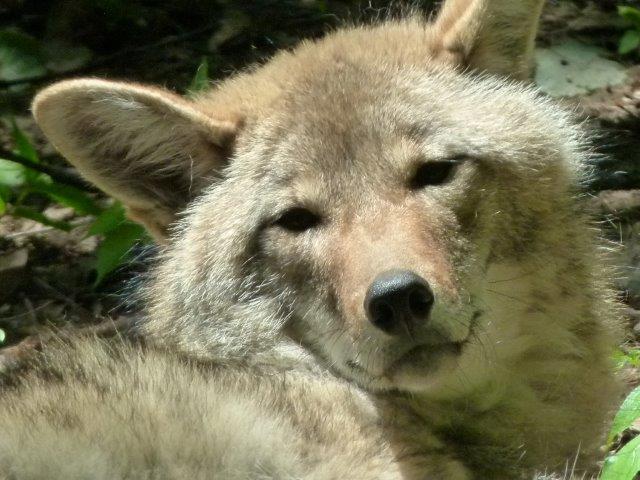
A cousin to dogs, wolves, and foxes, the coyote measures about 4 feet from head to tail, with a shoulder height of about 2 feet and a weight from 25-35 pounds. Eastern coyotes tend to be slightly larger than coyotes found in the west. They have a long and pointed muzzle with a small, rounded nose, and a keen sense of smell. They have sharp eyes, large sensitive ears that are directed forward, slender legs, and small feet with non-retractable claws. The fur is long, coarse, and dense that shows a slight seasonal variation, but varies greatly among individuals. There is not a difference in fur quality between males and females. Usually their colors is gray to cinnamon gray with the underside being buff gray and black.

Where do coyotes live?
The coyote's habitat in the east consists of brushy country bordering the edge of coniferous and second growth hardwood forests, also fields interspersed with thickets and marshlands. Coyotes do not do well in dense forests. Coyotes sleep on the ground in some cover all year but will make a den for their pups under a stump, hollow log, log pile, rocky ledge, vacant building, or dry culvert. They may even dig their own den or enlarge an abandoned burrow. A coyote den may be 2 to 4 feet underground and up to 30 feet long. It may have one or several concealed entrances in high vegetation. The home range of a coyote may be 2.5 to 26 square miles depending on the availability of prey.

What do coyotes eat and what eats them?
Coyotes are opportunists and eat a variety of animals including carrion, rabbits, white-tailed deer, rodents, insects, birds, snakes, frogs, lizards, turtles, fish, crayfish, and vegetation like grapes, apples, cherries, berries, and grasses. The main prey of coyotes tends to be rabbits, carrion, and rodents. Coyotes will often bury a meal if they are unable to finish it and return to it at a later time. There are few predators of the adult coyote aside from humans; young pups have more including the wolf, great horned owl, cougar, bear, golden eagle, and humans.

How do coyotes adapt?
Coyotes are active year round and are chiefly active at dawn and dusk and it is not uncommon to see one out during the day. They often lead a solitary existence or travel in a small "pack" consisting of a mated pair, the pups of the year, and possibly an older offspring. Coyotes are curious animals with a willingness to experiment with new food items and adapt quickly to new situations using it to their advantage. They may sometimes follow large animals using them to flush rodents and insects from a field or will scavenge along a highway. Coyotes may work in pairs to catch prey, splitting off from each other with 30 to 200 feet between them and walking parallel for some distance. They then come together for a short while and split again. A coyote may stalk and creep up on its prey, freeze momentarily, and then pounce like a fox or may hunt by chasing an animal in relays with other coyotes. A coyote usually attacks its prey from the front biting the victim at the throat and cutting the jugular vein, although they often attack the rear end of a deer. The keen sense of hearing, sight, and smell are very important to the coyote when hunting. They usually trot when hunting but may run as fast as 25 to 30 miles per hour. Coyotes are also strong swimmers and with their thick fur are well equipped to survive in temperatures as low as 20 to 30 degrees below zero. Coyotes communicate by howling, barking, and yipping. They also communicate by using their scent glands, and urine and scat posts to mark their territories.

How do young coyotes develop?
Coyotes may pair together for several years but do not mate for life. Breeding begins in February and gestation lasts for 60 to 65 days with the pups born in April or May. The litter size is normally 5 to 7 blind and helpless pups covered with dark, tawny hair. They are able to crawl after about 3 days and walk at 8 to 10 days. The eyes open at 10 to 14 days and they can run at one month old. The female may move the pups from one den to another during their first few weeks of life. The pups are nursed for two weeks and then begin to eat partially digested food as well as continue to nurse. The male provides the food for the pups and the femals until they are old enough to venture out of the den at 3 to 6 weeks old when they are weaned. The pups are taught to hunt by both the male and female at 9 weeks of age. The family will stay together until early fall. If a coyote survives its first year of life it may live to be 4 to 5 years old or if it is lucky 10 to 15 years.

Fun Facts!
  • Coyotes may work in pairs to catch prey, splitting off and running parallel to each other before coming back together.
  • Eastern coyotes tend to be larger than western coyotes.
  • Coyote pups are born blind and helpless but can run after just a month.

August 6, 2014

The Life and Times of the Exhibit Coyote

By Marianne O’Loughlin, Program Intern


On May 1, the male coyote made his exhibit debut and has been one of the Science Center’s most popular exhibit animals ever since. He started as a program animal when he arrived in 2008, but since another coyote arrived in 2013, he’s become a full-time exhibit animal. While the coyote is still a wild animal, he’s gotten used to a human presence from his time as a program animal. He can often be seen running to the exhibit window to investigate visitors, as curious as any wild coyote might be. Coyotes in the wild use this natural curiosity to adapt quickly to new situations. He’s quite the howler, too. If you hear any long, shrill calls anywhere around the Science Center, it’s probably the coyote. His voice carries almost everywhere. Listen in the mornings for the younger female’s response. Since the coyote is so curious, it’s important to give him new experiences every day. Animals at the Science Center, just as in the wild, need to exercise their brains as well as their bodies. We do this by engaging them to practice the same skills they might use in the wild: these new experiences are formally called “enrichment.” Enrichment might involve new objects to see, such as toys or a mirror. Coyotes in the wild are adaptable and are constantly exposed to new things in a variety of habitats.

Most of the time, enrichment involves a new kind of smell. Coyotes in the wild use their supercharged noses to sniff out prey or the trail of another coyote. At the Science Center, the exhibit coyote might smell oregano, nutmeg, vanilla, coffee, or even the scents of other Science Center animals hidden throughout his exhibit. Keep an eye out for the coyote sniffing logs, rocks, or the edges of the exhibit where the scents might be hidden.

Of course, it’s important to have enrichment that the coyote can touch and interact with, too. Since wild coyotes eat a huge variety of animals (and garbage humans leave behind), the exhibit coyote gets some extra treats in addition to his fortified diet. Fish blood, grape juice, jam, “mouse-sicles,” and peanut butter are all on the menu on occasion. We hide food in logs and behind rocks throughout his exhibit so he has to use his sense of smell to find his treats. We also cycle in different logs and rocks in his exhibit so hiding places won’t be predictable.

Coyote FAQ

Do coyotes hunt in packs?
Yes, and no. Coyotes in the east and west are slightly different from one another. Western coyotes are more solitary than their eastern counterparts.

What’s the coyote’s name?
Squam Lakes Natural Science Center's live animals serve as valuable teaching tools to educate our audiences about each species’ role in its environment. To reduce focus on the individual animal and the inherent risk of making wild animals appear as "pets," the Science Center does not use "pet" names for exhibit or program animals. While coyotes are related to dogs, they can never be truly domesticated or “tame.” Animal care staffers work with the coyote under “protected contact,” meaning that when cleaning out holding areas or the exhibit, the coyote is always in a separate area.

How many coyotes are at the science center?
Currently, we have two coyotes. The older male is on exhibit and the younger female is strictly a program animal.

Are coyotes vicious?
Coyotes have powerful teeth and jaws for capturing prey, but unless they lose their fear of humans, they will not actively harm humans unless frightened or threatened. They would rather hunt mice and other small animals and stay out of harm’s way.

The coyote’s looking skinny today. Why is that?
Just like a long-haired dog, coyotes shed their winter coats when the weather gets warm. Often, wildlife photographers capture photos of animals in winter when their coats are thick and vibrant. While animal winter coats look beautiful in pictures, they’re not useful in the hot summer months. The fur gradually sheds off, leaving coyotes looking thinner and sometimes patchy. This is also why the red foxes tend to look scruffier in the summertime. Drop by as the weather gets cooler and you’ll start to see the animals with thicker coats.

June 23, 2014

Coyote Day

By Madeline Warren, Marketing Intern

The one thing I love most about Squam Lakes Natural Science Center is how interactive and lively the animals are. Out of all the animals at the Science Center my favorite is the coyote. I remember my first time walking the trail at the Science Center I was so amazed by the coyote exhibit. When the coyote came right up next to me I could hardly believe what was happening; I had never seen a coyote up close before. His eyes were a deep auburn and reminded me of something you would see on the cover of a mystery book. There were some children playing around the coyote exhibit pretending to be coyotes and howling. I think the coyote thought one of his own was nearby because then he let out a loud howl! I thought I was dreaming because it was unlike anything I had ever seen or heard before.

I’m not the only one who loves our new coyote exhibit. Staff, volunteers, and visitors love the coyote exhibit too which is why Squam Lakes Natural Science Center is dedicating an entire day to teaching our guests about these wonderful wild creatures. Coyote Day, Saturday, June 28th will be filled with coyote education, crafts, scavenger hunts, and fun! The day will start out with coyote crafts at 10:00 so be ready to allow your artistic abilities to run wild. After crafts at 11:00 there will be an “Up Close to Animals” program that will feature a live coyote. Don’t miss out on this great opportunity to be in the same room as a coyote and speak to coyote experts about this amazing animal.

At 1:00 p.m. is the event Science Center staff has been eagerly waiting for. This event is a presentation by Chris Schadler from Project Coyote about Eastern Coyotes in New England. Science Center Naturalist Margaret Gillespie is especially excited for this Eastern Coyote presentation because the Science Center’s newest coyote is eastern. It’s going to be very interesting hearing this talk about Eastern Coyotes and then getting to meet a real live Eastern Coyote.

The fun doesn’t stop at the coyote presentation. After the presentation there will be coyote games on the lawn below the Bluestone Terrace. Bring your friends and family to test each other’s skills in games about coyotes. Finally, if you missed the earlier “Up Close to Animals” program don’t worry! The day comes to a close with another “Up Close to Animals” that will feature a live coyote.

You don’t need to already know a lot about coyotes to enjoy this day, but you will certainly learn a lot. If you have any questions about coyotes they will surely get answered. Science Center volunteer docents will be at our coyote exhibit all day answering questions and informing visitors about these fascinating creatures. There is definitely something for everyone at Coyote Day, no matter what age, if you’re a coyote expert, want to learn more, or just want to have a fun time. Don’t forget to be on the lookout for scavenger hunt items all throughout the day. You can pick up a list for the scavenger hunt at Admissions. Squam Lakes Natural Science Center can’t wait to see you at Coyote Day! Below is a full schedule of events for Coyote Day.

Coyote Day Program Schedule:
  • 10:00 a.m. to 2:00 p.m. - Coyote Crafts (Bluestone Terrace) 
  • 11:00 a.m. - Up Close to Animals: Live Coyote (Classroom 3, Webster Building) 
  • 1:00 p.m. - Becoming Wolf: The Eastern Coyote in New England Presentation by Chris Schadler from Project Coyote (Classroom 3, Webster Building) 
  • 2:00 - 3:00 p.m. - Coyote Games (Lawn below Bluestone Terrace)
  • 3:00 p.m. - Up Close to Animals: Live Coyote (Classroom 3, Webster Building) 
  • Coyote Scavenger Hunt - All Day (pick up at Admissions) 
  • Volunteers at new Coyote Exhibit all day

February 10, 2014

About the Eastern Coyote

Canis latrans

Kingdom: Animalia
Phylum: Chordata
Class: Mammalia
Order: Carnivora
Family: Canidae
Genus: Canis
Species: C. latrans

Lifespan: 10-15 years in captivity, 4-5 years in the wild
Size:4 feet long; 24 inches shoulder height; weight 25-35 pounds
Offspring: 5-7 young
Status: common

What do coyotes look like?  
A cousin to dogs, wolves, and foxes, the coyote measures about 4 feet from head to tail, with a shoulder height of about 2 feet and a weight from 25-35 pounds. Eastern coyotes tend to be slightly larger than coyotes found in the west. They have a long and pointed muzzle with a small, rounded nose, and a keen sense of smell. They have sharp eyes, large sensitive eats that are directed forward, slender legs, and small feet with non-retractable claws. The fur is long, coarse, and dense that shows a slight seasonal variation, but varies greatly among individuals. There is not a difference in fur quality between males and females. Usually their colors is gray to cinnamon gray with the underside being buff gray and black.

Where do coyotes live?  
The coyote's habitat in the east consists of brushy country bordering the edge of coniferous and second growth hardwood forests, also fields interspersed with thickets and marshlands. Coyotes do not do well in dense forests. Coyotes sleep on the ground in some cover all year but will make a den for their pups under a stump, hollow log, log pile, rocky ledge, vacant building, or dry culvert. They may even dig their own den or enlarge an abandoned burrow. A coyote den may be 2 to 4 fee underground and up to 30 feet long. It may have one or several concealed entrances in high vegetation. The home range of a coyote may be 2.5 to 26 square miles depending on the availability of prey.

What do coyotes eat and what eats them?  
Coyotes are opportunists and eat a variety of animals including carrion, rabbits, white-tailed deer, rodents, insects, birds, snakes, frogs, lizards, turtles, fish, crayfish, grapes, apples, cherries, berries, and grasses. The main prey of coyotes tends to be rabbits, carrion, and rodents. Coyotes will often bury a meal if they are unable to finish it and return to it at a later time. There are few predators of the adult coyote aside from humans; young pups have more including the wolf, great horned owl, cougar, bear, golden eagle, and humans.

How do coyotes adapt? 
Coyotes are active year round and are chiefly active at dawn and dusk and it is not uncommon to see one out during the day. They often lead a solitary existence or travel in a small "pack" consisting of a mated pair, the pups of the year, and possibly an older offspring. Coyotes are curious animals with a willingness to experiment with new food items and adapt quickly to new situations using it to their advantage. They may sometimes follow large animals using them to flush rodents and insects from a field or will scavenge along a highway. Coyotes may work in pairs to catch prey, splitting off from each other with 30 to 200 feet between them and walking parallel for some distance. They them come together for a short while and split again. A coyote may stalk and creep up on its prey, freeze momentarily, and then pounce like a fox or may hunt by chasing an animal in relays with other coyotes. A coyote usually attacks its prey from the front biting the victim at the thoat and cutting the jugular vein, although they often attack the rear end of a deer. The keen sense of hearing, sight, and smell are very important to the coyote when hunting. They usually trot when hunting but may run as fast as 25 to 30 miles per hour. Coyotes are also strong swimmers and with their thick fur are well equipped to survive in temperatures as low as 20 to 30 degrees below zero. Coyotes communicate by howling, barking, and yipping. They also communicate by using their scent glands, and uring and scat posts to mark their territories.

How do young coyotes develop?
Coyotes may pair together for several years but do not mate for life. Breeding begins in February and gestation lasts for 60 to 65 days with the pups born in April or May. The litter size is normally 5 to 7 blind and helpless pups covered with dark, tawny hair. They are able to crawl after about 3 days and walk at 8 to 10 days. The eyes open at 10 to 14 days and they can run at one month old. The femals may move the pups from one den to another during their first few weeks of life. The pups are nursed for two weeks and then begin to eat partially digested food as well as continue to nurse. The male provides the food for the pups and the femals until they are old enough to venture our of the den at 3 to 6 weeks old when they are weaned. The pups are taught to hunt by both th emale and female at 9 weeks of age. The family will stay together until early fall. If a coyote survives its furst year of life it may live to be 4 to 5 years old or if it is lucky 10 to 15 years. 

Be sure to visit the Science Center's new Coyote Exhibit which will open spring 2014!