Showing posts with label new hampshire. Show all posts

September 18, 2017

The soft hues of fall (maple leaf viburnum and hobble bush)

By Eric D'Aleo, Naturalist

Walk through any forest in the northeast in the fall and you are sure to be struck by the brilliance of the colors of the foliage. Many visitors to New Hampshire look forward to mountain ranges robed in various shades of bright colors or search for scarlet-leafed maples along the back roads of small towns. When people walk the trails throughout the state their gaze is often pulled skyward to look at the gold of the aspens and birches, the orange of the oaks, and the red of the maples. However, do not forget to search beneath the brilliant colored canopy for the softer and more subtle hues of the season.

The maple leafed viburnum is a shrub often mistaken for a young red maple tree because its leaves have a similar appearance. A mature plant may reach a height of three to six feet and is often found in the shade of upland forests consisting mainly of beech and maple. In the fall this shrub’s foliage comes in various pastel shades of pale yellow, light pink or a deeper rose color. Often these colors are on several leaves of the same plant or all on the same leaf. The fruit turns a dark blue and is eaten by turkeys, robins, cedar waxwings, flickers, bluebirds, cardinals, flycatchers, thrashers, thrushes, and woodpeckers. In the spring and summer the leaves are a larval food source for the spring azure butterfly and the flowers are a nectar source for the golden-banded skipper.
Maple leaf viburnum
flickr/Katja Shultz
Another understory shrub often overlooked until it “trips” you is hobble bush. Also known as witches hobble the plant is found in rich, moist, wooded areas. The shrub can grow to a height of six to twelve feet and has the ability to root when a branch bends down and touches the ground. This creates dense thickets of plants that make traveling through them difficult. Tripping hazard aside, the shrub’s leaves turn a burgundy to dark plum color in the fall. If the central portion of the leaf still remains green it reminds me of a sliced kiwi whose colors are reversed. The berries also ripen in the fall, changing color from red to dark blue and may be eaten by ruffed grouse, cedar waxwings, brown thrashers, squirrels, and chipmunks. So don’t overlook these lesser known fall color artists, look for their softer hues hidden in the forest and you will be rewarded.
Hobble bush
flickr/US Fish & Wildlife Service

August 14, 2017

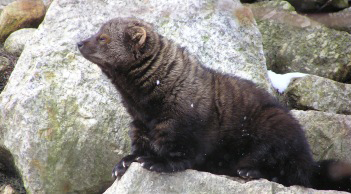
Fisher

Martes pennanti 
Kingdom: Animalia
Phylum: Chordata
Class: Mammalia
Order: Carnivora
Family: Mistelidae
Genus: Martes
Species: M. pennanti

Fast Facts:
Lifespan: 3-4 years in the wild
Size: 31-47 inches in length, weight 4.5-12 pounds
Offspring: 1-4 young
Status: Populations have recovered from extreme lows in early to mid-1900

What do fishers look like and what animals are their relatives? Dark brown to black in color with a silver tinge to the head and shoulders, fishers are medium-sized mammals similar in size to a fox. Fur tends to be softer and darker in females. Short legs bring them close the ground and they bound with hind paws landing in the place of the front paws, leaving sets of two foot prints side by side. Male fishers average about 10 to 12 pounds but definite sexual dimorphism is evident, with females being a little over half the weight of males. Fishers are members of the family Mustelidae, with relatives being weasels, martin, mink and otters.

What kind of habitat do fishers favor? Fishers prefer continuous forest with a thick canopy, translating in the northeast to dense lowland coniferous forests or a mixed forest of conifers and hardwoods. In distribution, fishers are found in southern Canada, New England, New York state and several other northern states. Home range varies from a little over two to 15 square miles depending on the quality of the habitat.

What do fishers eat? Fisher prey upon snowshoe hare, squirrels, mice, and birds, but perhaps their most intriguing catch is the porcupine. Although not immune to porcupine quills, the fisher has a hunting technique that results in it getting few quills. Using agility to its advantage, the fisher circles the porcupine, looking for opportunities to bite at its unprotected face, while staying away from its powerful tail. Even if the porcupine tries to climb a tree, the arboreal fisher can climb above it and threaten it back to the ground. After about one-half hour, the porcupine may be weakened enough for the fisher to flip it over and attack the ventral side, which has no quills. Porcupine quills rarely cause infection in fishers and accidentally ingested quills often end up in fisher scat! Fishers will also eat carrion. It is unusual for a healthy adult fisher to become prey itself.

Fun Facts! 

  • Do fishers eat fish? Although they will readily eat fish, individuals rarely, if ever catch them. In his comprehensive reference book, The Fisher, Roger A. Powell concludes that the best source of the name was early settlers who noted the similarities between the fisher and the European polecat. Other names for the polecat were fitch ferrets, fitchet, fitche and fitchew – not a big leap to the name “fisher.” 
  • In New England we commonly hear this animal being called a “fisher cat”, a confusing label since fishers are not in the cat family. 
  • Active day or night, fishers are more nocturnal in proximity to people. 
  • What about those screams in the night? Those loud calls are probably porcupines or perhaps owls or foxes rather than fishers. 
  • Now, what about fishers being responsible for the disappearance of domestic cats? Fishers can prey upon cats, but Great Horned Owls, coyotes and cars take a more significant toll. Keeping cats in at night is a good solution.

April 3, 2017

The lesser known New Hampshire heralds of spring

By Eric D'Aleo

April proclaims the beginning of spring on the calendar but is not always evident here in New Hampshire. Although southern New England may have green shoots poking through the soil and the hint of warm temperatures, further north there may still be snow on the ground and ice on ponds and lakes. However, there are still signs of spring. One I look for is the return of two small diving ducks: the hooded merganser and the common goldeneye.

The hooded merganser is a small but striking duck. Males have high contrast markings of black and white on their head, back, and chest, a brown scalloping pattern along its sides, a bright golden eye, and a slender black bill. Females are more subdued in their coloration, consisting mainly of browns and tans, with a red eye, and yellow bill similar in appearance to the male’s bill. Both males and females have a high crest on their head that looks like a Mohawk and can be raised and lowered at will. This species of duck prefers to feed in ponds and quiet waters of lakes and rivers. Once the ice opens up to reveal the water the mergansers return shortly afterwards. I have spotted them on the Squam River in Ashland during winter thaws only to disappear when it gets cold again and the ice reforms. Yet by March and April, the temperatures are warm enough to keep a permanent channel of water open, although the shoreline may still have ice. Then hooded mergansers are seen in pairs or small flocks as the males begin courting the females with their white, sail-like crests raised. Occasionally a male will make a low, gravely, groaning call advertising his fitness and interest in breeding. These small ducks also often dive beneath the surface in search for crayfish, aquatic insects, tadpoles, snails, and other mollusks on the river bottom.

Common Goldeneyes may also be seen briefly at this time as they pause on their spring migration north. The male has a black head with a white cheek spot next to its bill and a black back and tail. The chest and sides of the bird are white, while the female has a brown head with a gray body and wings. Both sexes have a bright yellow eye. These birds spend the winter along the New Hampshire coast and on large inland lakes or rivers where the water remains open. The goldeneye, like the hooded merganser, is a diving duck, using its back feet to propel it underwater. The diet of the goldeneye is similar to the hooded merganser, consisting of crayfish, mollusks, aquatic insects, and fish eggs on aquatic vegetation. Both species are very wary and best observed from a distance with binoculars.


August 6, 2012

Getting Nearer to Nature

By Peter Kleinhenz, Program Intern

Nature seems to be one of those “so close, yet so far away” aspects of our society. We rely on nature for our food, for our water, for our shelter, and even for the air we breathe, yet it seems so…distant. Why is that the case, and what can we do to change it?

Humans, in a sense, belong in the natural world. Recent studies have highlighted the importance of being out in nature as a child and the effect it has on things like attention and the ability to learn. On an even broader scale, nature can teach us so much about the world and the benefits we can all reap from treating it with care. More and more, nature needs all the care it can get which stems from the human race choosing to separate itself from nature at an ever-increasing rate.

If the world is a giant art gallery, humans are tearing masterpieces off the walls and replacing them with framed scribbles on paper. Sure, our society has advanced which requires more buildings, more space, and less nature. But, lately, things have been getting ridiculous. An example here in New Hampshire is the clearing of wetlands and forests for strip malls, to put in the same stores that can be found only blocks away. Have we, as humans, forgotten the beauty of a cascading waterfall, the sounds of migrating birds, or the stillness one can only experience when amidst ancient trees? We are making it harder on ourselves to enjoy a world at its more basic, at its most peaceful, and at its most awe-inspiring. The great news, though, is that there is plenty of nature left, right under our noses, which we can still explore if we just know where and how to look!

I moved to New Hampshire about two months ago and was instantly struck by how few people knew about the awesome places right around them, including the Science Center. The Nature Conservancy, as it does in every state, has done an absolutely fantastic job of protecting the most significant natural areas in the state. Preserves such as Mt. Tenerife, Ossipee Sand Barrens, and Packer Bog are easy to find places that harbor some of the most interesting, and threatened, species of plants and animals in the state. Similar preserves, whether owned by The Nature Conservancy, other private organizations, or the state can be found throughout New Hampshire and provide the eager naturalist with plenty of opportunities to discover nature they may not have the chance to see otherwise. But what if you don’t want to drive all over the state? Don’t worry…nature is closer than you may think.

Even in the face of wanton destruction, nature has a resilience and adaptability that is quite impressive. Because of this, interesting finds can be made close to home at any time of the year, even if the amount of “nature” is minimal. You just have to be out there and keep your senses open. In March and April, follow the sound of calling frogs to vernal pools, where you can literally watch spring arrive on warm, rainy nights as salamanders and frogs migrate to the pools to lay their eggs. From mid-April to mid-May, scan trees for migrating warblers, the jewels of the tree tops, as they pass through during their northern migration. Summer is a great time to see animals raising their young around (and, sometimes, in!) your home, which makes the biting insects at this time of year slightly more tolerable. Fall brings the return of all types of birds as they head for warmer places and the changing leaves make heading out into nature seem like stepping into a dream. Winter might be cold, but it provides anyone with the opportunity to see the tracks of animals they might not even know live in their area. Fishers, bobcats, and mink can be easily followed in the snow and you might be surprised at how close these incredible animals, commonly attributed to wilderness areas, can be found to your home.

The takeaway message from this is…get out! Set off on a new adventure, even if it is right by your house, to discover how good it feels to be connected to nature. Open your mind to all that nature can teach you and use that knowledge to motivate your friends to do the same. Your friends, and you, will be so much better for it.

Links to Help You Get Started:
http://www.nature.org/ourinitiatives/regions/northamerica/unitedstates/newhampshire/index.htm
http://www.nwf.org/In-Your-Backyard.aspx
http://mdc.mo.gov/landwater-care/homeowners/backyard-wildlife/landscaping-backyard-wildlife