Showing posts with label white-tailed deer. Show all posts

March 26, 2018

Stories to Tell – Winter Clues

By Eric D'Aleo

Each trip outside to check the trail cameras is an adventure because I don’t know what I will find. Most of the time it is routine with the unexpected being the images captured by the cameras, but that is not always the case. Sometimes scat is left behind and the identification mystery begins. Questions run through my mind as I study the scat on the ground. Is the scat in a prominent location, such as a rock, log, or in the middle of a trail? How large is it and what is its shape? Are there any food items identifiable in the scat? Scat is found throughout the year, but for tracks, winter is the best time of year to look for them. I see many tracks as I move from one camera location to another. Sometimes they are fresh and easy to identify and other times they may be days or weeks old, making identification more challenging. Again, I run through a series of questions to help me identify the tracks. What’s the size of the track? How many toes are visible? How is the animal moving? Is it walking, bounding, or hopping? Where are the tracks located? Are they in a forest, in a field, or in a wetland? Do the tracks lead to a tree, a brush pile, or a burrow? The answers to these questions may provide a clue as to what animal made the tracks.

Look at the scat and tracks that were found during the past year and see what ones you can identify.


Occasionally, other unusual signs of an animal’s presence are discovered. Look at the photo below. What do you think was found on the snow this January? At the time of discovery, the snow had a hard crust and there were no foot-prints in the area. The location was near a trail camera, but was not in its line of view. When I checked the camera’s memory card I saw no evidence an animal had been in the area since the last time I had been there. The area is a mixture of conifers, mostly hemlock, and hardwood trees, beech, red maple, and oak. The object was not found near any tree. So, what was it?


The tail of a flying squirrel! My next question of course was what happened to the rest of the animal? This question was left unanswered since the hard snow crust offered no additional clues.

A similar experience happened in early March. Again, the body part from an animal was found on a hard snow crust with no animal tracks nearby. However, it was found in the snowbanks of a parking lot. Look at the photo below to identify what animal it came from.


It was the foreleg of a white-tailed deer. How had it died? Did it starve? Was it preyed upon? What animal brought the leg and left it here? Was it left there on purpose, was the amount of meat left on the leg too small to hold on to, or was the leg dropped to flee quickly from the area? More unanswered questions, but ones that keep me coming back for more, like a good mystery. What animal stories are waiting to be discovered where you live? Find out.

January 31, 2017

Stories to Tell - November Rut

By Eric D'Aleo, Naturalist

It’s amazing how much animal activity there is in the woods during the fall. Many hunters are aware of the movement of animals at this time, especially white-tailed deer, as they get ready for winter. The deer are busy feeding on the remaining green foliage in November and acorns to put on as much body fat as possible. It’s exciting to watch the changes that have occurred over the past few months on our trail cameras. Gone are the deer’s red coats of summer covered over by dark brown guard hairs of their winter coat which help them survive the cold weather. Fawns that once had spotted coats have grown and lost all trace of their baby coloration. The most noticeable change in the deer are the male’s antlers which have lost the velvet appearance revealing hard bone underneath to advertise their fitness to does and other males. All in time for the white-tailed deer’s breeding season, also known as the rut.

There was a lot of deer activity on our trail cameras from October through November. Most of it occurred late at night but there were times during the day when deer were active. It seems that several does and their offspring continued to routinely visit different locations on our property like they had during the summer. Yet one location, a crossing of two well-travelled paths, seemed to be visited by them most often. There was also evidence of more males on our property this fall than over the summer. There may have been as many as five bucks moving throughout the property. Some of them were young with small antlers but two were large bucks who spent a lot of time roaming around the woods looking for a doe that was ready to breed. Occasionally there would be a close up view of an antler on our camera, either because a buck was interested in it or was possibly choosing to investigate a young tree or sapling nearby where it could take out aggression by rubbing its antlers on the trees. Take a look the photos below.

Notice the difference in the color of the fur in the summer and the fall.
Fall coloring
Summer coloring

Although the fawn is not the same distance from the camera in each photograph, notice the disappearance of the spots by the fall.


Here are images of two different bucks from the same location.  Can you tell which one is more likely to be the dominant male?


Here are the two bucks again at different locations but exhibiting the same behavior.  They are smelling the ground for evidence of a female that is ready to breed.


This location proved to be a good spot for the does and their offspring to visit throughout the summer and into the fall.


This image was taken in early December.  Now with the breeding season over, the long winter begins.  When more snow accumulates, this area will be abandoned for stands of conifers that provide more protection for the deer from the elements.

February 29, 2016

Night at the Science Center

By Eric D'Aleo, Naturalist

Have you ever wondered what happens at Squam Lakes Natural Science Center in the off season or at night? Well, we have too, especially after we’ve all gone home for the day. So this winter we were able to start discovering answers when a local supporter offered to set up a number of wildlife trail cameras on our property. To date we have captured images of 6 species: including red fox, white tailed deer, eastern coyote, wild turkey, raccoon and grey fox. What seems to be by far the most photographed is the flock of about a dozen turkeys. They have shown up on all of the trail cameras both in the field and in the woods multiple times a day past some of them. We hope to be able to continue this project throughout the year and on different locations on our property. Take a look below at some of our “off season visitors”.
 Red Fox – Walking through
Gray Fox – This image was taken several days later in same location as the red fox photo.Can you tell the difference between both foxes? 
An Eastern coyote stopping to investigate a smell – This is not either of Squam Lakes Natural Science Center coyotes taking an evening stroll.
Raccoon – Walking through
A somewhat nervous White tailed deer
 A flock of wild turkeys foraging for food

November 24, 2014

Animal Facts: White-tailed Deer

Odocoileus virginianus 

Kingdom: Animalia
Phylum: Chordata
Class: Mammalia
Order: Artiodactyla
Family: Cervidae
Genus: Odocoileus
Species: O. virginianus

Fast Facts
Lifespan: 4-5 years in the wild; 15-20 years in captivity
Size: up to 80 inches long, 39 inches at the shoulder, weight 50-300 pounds
Offspring: 1-2 fawns, sometimes 3
Speed: 30 mph, 25 mph over long distances
Status: Common, widespread

What are some special characteristics of white-tailed deer?
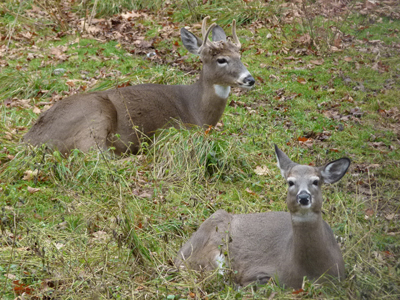
In summer, deer fur is reddish brown, short and wiry while in winter they grow a thick, gray coat. Winter guard hairs are hollow, providing extra insulation. The belly, throat and underside of the tail are white. Deer are ungulates or hoofed mammals and have pointed cloven hooves. Their large ears and dark nose are distinctive. How can you tell a buck and doe apart? Bucks are larger and vary from 75 to 300 pounds whereas does range from 50 to 200 pounds. Antlers distinguish bucks but each year antlers are shed in early winter.

What is the habitat of the White-tailed Deer?
Deer are found in mixed forest, along the edges of old fields and forest as well as in thicket areas. Depending upon the quality of their habitat, they may have a home range of two to three square miles. In winter, if snow depths exceed 15” deer gather in “deer yards” – areas often with coniferous cover where the snow is less deep and there is protection from wind. Packed trails lead to their winter food supply.

Deer are called browsers. What does that mean?
Browsers eat twigs and buds and a deer’s preferred winter browse comes from white cedar, hemlock and maple. They need about five to nine pounds of food per day in winter. Acorns are a staple food in the fall, with a bonus coming from the fruit of wild apple trees. During the warm months deer will eat tender green grass shoots.

How about the rutting season and raising of the young?
The breeding season or “rut” runs from October to December during this time bucks compete for does. In September the males rub off the velvet that covered their antlers. Healthier bucks have larger antlers and usually this visual sign is enough proof of their strength to other bucks without the need of physical contact, although similar sized bucks may spar with their antlers. Fawns are born in May or June. At first fawns lie hidden, and having no scent initially, their spotted camouflaged coats hide them well. Spots disappear with the first winter coat and fawns remain with the doe for about a year.

Fun Facts!
  • Deer have no upper incisors so browsed twig ends are ragged rather than clipped cleanly as by a rabbit or hare.
  • Deer have amazing jumping abilities and can soar over an eight foot fence.
  • Deer’s eyes are located toward the sides of their head so they have good vision behind them to see predators.
  • Noises? There are a wide variety including bleats, whistles, whining sounds, loud snorts and squawks.