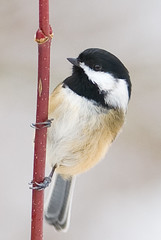
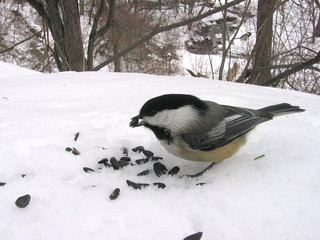
Black-capped Chickadees with their distinctive black, white, and gray plumage are a familiar bird in New England. Yet to most of us, when we see one Chickadee it looks just like another. Occasionally one stands out such as the one that comes to the feeders at my home. This individual is easy to identify due to its several white tail feathers, meaning it is piebald or partially albino. Rarely you might see one with several colored plastic bands attached to one leg. This means a local researcher, authorized by the US Fish & Wildlife Service, marked it to help identify the different birds in that local population.

Over the past forty years I have banded well over a thousand Chickadees and recaptured nearly as many. You might think that after a bird has gone through the trauma of being captured once it would try to avoid being captured again. With Chickadees that doesn’t seem to be the case. A number of years ago I banded one Chickadee and recaptured it a dozen times in the same day it was banded! Still most of the Chickadees are only recaptured infrequently and usually within one to two years of having been banded. Indeed the average Chickadee only lives one to two years, but a few individuals survive much longer. That brings us to Chickadee 2200-79973.
 I first “met” Chickadee 2200-79973 on February 9, 2005. I don’t know if this individual was a male or female as both sexes look alike for most of the year. The sexes can only be determined for a brief time during the breeding season, and then only while in the hand by peeking beneath the underside feathers. (Females have a brood patch on their bellies and males a distinct swelling at their rear end opening called a cloacal protuberance.) At the time of banding Chickadee 2200-79973 was an average Black-capped Chickadee with a 65 millimeter wing chord (wrist to longest feather), 63 mm tail, 10 mm bill, and a weight of 11 grams (there are 28.35 grams/ounce). This Chickadee was banded that day during a school program. The students not only got see this little guy or gal but had the opportunity to record the data, place the band on its leg, and release it. All agreed it was a special little bird, although I didn’t realize how special at the time.
The next time 2200-79973 was encountered was on January 7, 2006. Other than the tail feathers being 3 mm longer than the year before it seemed to be just the same. We didn’t see this feisty little character again until March 20, 2008. At that age it had it had already beaten the odds living much longer than 95% of Chickadees. On March 4, 2011, it was captured again making it the oldest surviving Chickadee I had ever banded. Then on February 28, 2014, I was really surprised, as you have probably guessed by now, 2200-79973 was waiting in one of the traps. I don’t know when this bird actually hatched, but the fact that it was banded in the winter of 2005 meant its minimum age was at least 10 years. Although the North American longevity record for a Black-capped Chickadee is twelve years, five months, this incredible little bird had survived three years longer than the next oldest Chickadee I have banded. It is going on nearly three years since 2200-79973 was last encountered, but you can bet that every time I take a Chickadee from one of the traps, I haven’t given up hope that he or she might just prove to be the ultimate Chickadee survivor. Or maybe after getting caught five times in ten years he or she might just have figured out how not to get caught!
If you would like to find out firsthand how we catch, measure, and band Chickadees and other birds that visit our feeding station, you can join us on the following weekends this winter, on January 7 and 21, February 4, 18, and 23, and March 1 and 4. See full details and schedule at http://www.nhnature.org/programs/calendar.php.