By Iain MacLeod
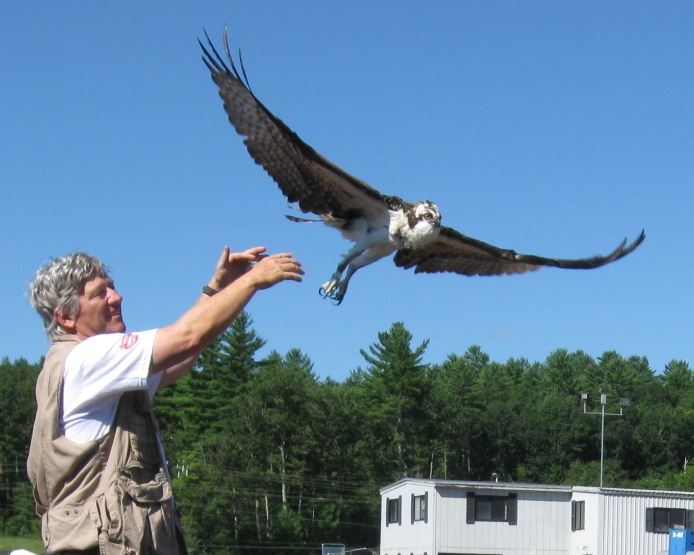
Four of five closely watched satellite-tagged New Hampshire Ospreys have crossed the Caribbean and reached South America. Researchers and educators from Squam Lakes Natural Science Center have been following the large, fish-eating birds since they were fitted with light-weight, GPS-enabled, solar powered transmitter backpacks earlier this year.
Two of the birds – brothers Artoo and Bergen -- are the sons of Art, the adult male Osprey that was followed in 2012 on his amazing 5,000 mile journey from his winter home in Brazil to his nest in Bridgewater. Art was recaptured in August by Science Center Executive Director Iain MacLeod and his research partner Dr. Rob Bierregaard, and relieved of his transmitter which he had carried for 14,000 miles. That transmitter was placed on his son Artoo.

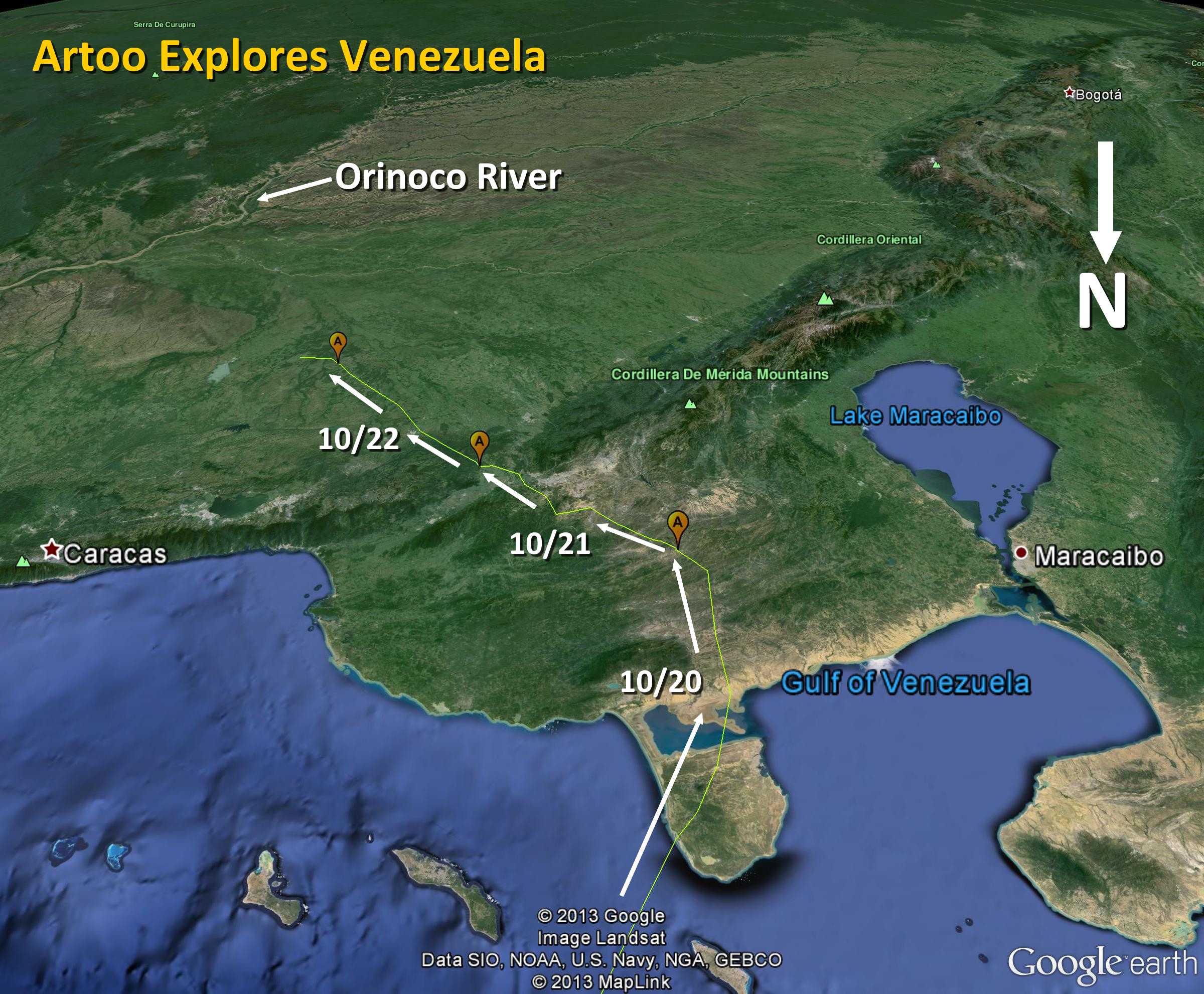
Artoo left the Bridgewater nest on August 16 and headed to Pennsylvania where he explored various rivers for several weeks. Bergen left a couple days later and spent a couple weeks on the Chesapeake Bay in Maryland. “Amazingly Bergen and Artoo crossed paths just to the west of the Chesapeake on the afternoon of September 23,” said MacLeod. “Then they both headed out over the open ocean (known as the “Georgia bite”), at one point only half a mile apart, through the following night and both returned to shore on the Georgia coast on the 24th.” They then took different routes down to Florida, but roosted within four miles of each other on the night of September 30. Both crossed to Cuba then to Haiti and the Dominican Republic. Bergen made a 500+mile over ocean crossing to the coast of Colombia on October 11 while Artoo lingered around the town of Higuey in the eastern Dominican Republic until October 20. He crossed to Venezuela – a 460+ mile crossing -- on the morning of October 21.

Bergen has settled into a remote Colombian river valley near the border with Venezuela, where he might spend the next 18 months before returning to New Hampshire in 2015. Juvenile Ospreys do not return north until they are two years old and ready to breed. “He may also just be staging there before moving to another location,” said MacLeod. “His brother Artoo now has to find himself a safe territory too where he can spend the next 18 months,” MacLeod added.
A third youngster, named Weber, left her nest in Hampton Harbor on September 6 and made an uninterrupted flight down to the Dominican Republic and crossed over the Venezuela on September 27. Sadly, she only lasted a little more than 24 hours in Venezuela before her signal stopped moving and researchers assume she died.

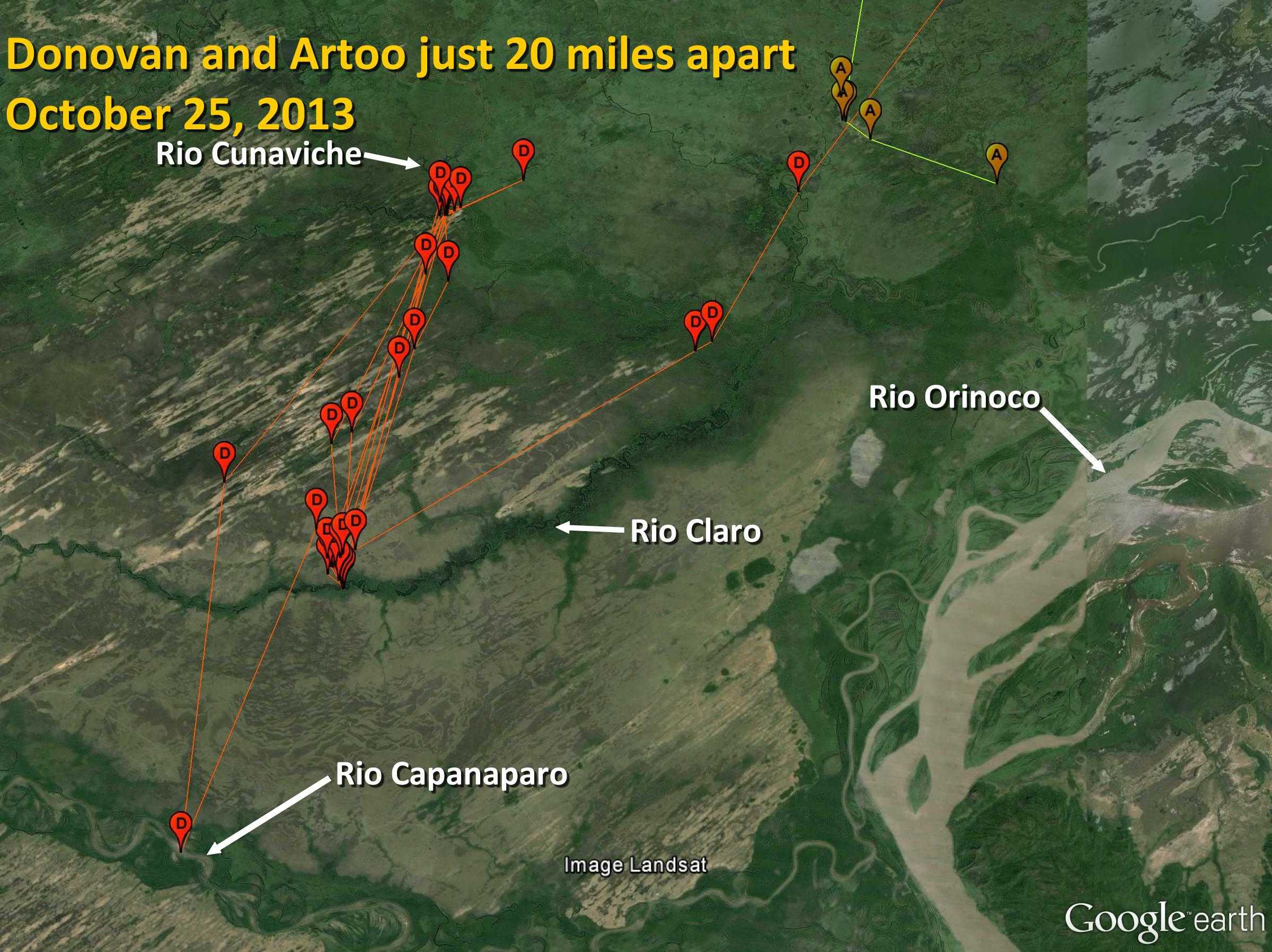
The fourth Osprey, an adult male named Donovan, was tagged at his nest in Tilton in late May. He is the father of Jill and Chip, two youngsters who were followed in 2012. Donovan left New Hampshire on September 17 and skirted just west of New York City, Philadelphia, and Washington on his way to Florida. He flew over the Bahamas on his way to Cuba, then over to Haiti, but then surprised MacLeod by continuing east over to Puerto Rico and then to the Virgin Islands. He ended up on St. Croix before making an attempt to cross the Caribbean on October 9, but changed his mind and returned to Puerto Rico. “Maybe he forgot something,” jokes MacLeod. After a week fishing around the town of Ponce on the south coast of Puerto Rico, Donovan flew back to St. Croix and completed a nonstop 660 mile trip across the Caribbean to Venezuela. Donovan then headed southwest and quickly reached the Rio Claro – a tributary of the mighty Orinoco River, where he has settled for the last couple days. “This may be his winter home,” said MacLeod. “Donovan is a mature bird who has made this migration several times. He knew where he was going -- Ospreys are vary faithful to both their winter and summer haunts and will return year after year to the same South American river,” added MacLeod.
The fifth tagged Osprey, an adult male named Mackenzie, died before leaving New Hampshire on the shore of Head Pond in Berlin – likely the victim of a Great Horned Owl or Goshawk attack. MacLeod recovered his remains in early October.
Squam Lakes Natural Science Center launched the project in 2011 with financial and logistical support from Public Service of New Hampshire (PSNH). In addition to PSNH support, MacLeod also gained project funding from the Jane B. Cook 1983 Charitable Trust and the Science Center’s own Innovative Project Fund. “PSNH has continued to be an annual supporter of this project and an outstanding steward of nesting Ospreys throughout the state,” said MacLeod. In addition to supporting this research project, PSNH has installed nesting poles, managed Osprey nests on their power lines and also runs a webcam on an Osprey nest at their hydro station at Ayers Island in New Hampton/Bristol.
You can follow the continuing journeys of Artoo, Bergen, and Donovan online. MacLeod authors a blog which provides regular updates and maps showing where each bird is and what lies in store. The blog is at
http://www.nhnature.org/programs/project_ospreytrack/.
MacLeod also authors an up-to-the-minute Twitter feed
@OspreyNH.