By Maggie Gaiero, Program Intern
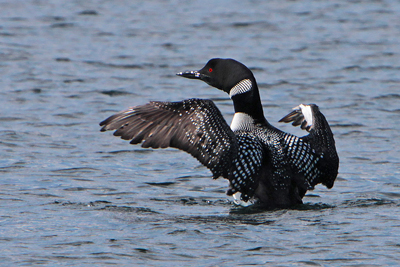
Many people are fascinated by these amazing animals swimming about on Squam Lakes. Sharing the waters with other birds like the Blue Heron, the Common Loon stands out with its recognizable black and white plumage. The Common Loon is one of five species of loon. Both Squam Lakes are blessed to have this bird call it home. Loons claim territory on the shorelines around the lakes, spending the majority of their lives in the air and swimming in the water. The Common Loon only comes ashore to lay eggs in early summer, but there is great danger to doing this. Eggs may become prey to animals like raccoons and turtles. Both parents stand guard on the nest and incubate the eggs as they try to prevent the loss of one of their precious chicks.

From the fall of 2004 to the spring of 2005, 44% of the loon population on Squam Lakes was lost. Out of the 16 pairs that flew south in 2004, only 9 pairs returned to lay eggs in 2005. More recently in 2014 there were 12 pairs of loons creating homes on the beautiful shores of Squam, and this summer 13 pairs were spotted. What caused such a dramatic drop from 2004 to 2005? Loons face many stresses in the wild even here at Squam. In 2001 with the reopening of the public boat launch, it was noted that human recreational use of the lake went up. Such acts can disturb nesting loons. Other stresses such as lead fishing tackle, extreme temperatures, and a high number of contaminants also have a negative impact on loons.
Here in New Hampshire the Common Loon is considered a threatened species. What exactly does this mean? A threatened species is characterized by a dramatic change in population – based on how many individuals are able to breed and the number of offspring that survive. The Loon is characterized as critical, meaning it is unable to sustain its population by itself in the wild in New Hampshire.
Squam Lakes Natural Science Center is concerned about this, so we have united with the Loon Preservation Committee (LPC) to offer Loon Cruises twice a week each summer. These cruises take visitors around Squam Lake. Participants see some artificial loon nest platforms made and monitored by the LPC. They also hear about conservation ecology for the Common Loon. The boat trip lasts for 90-minutes. It is a great way to spend an afternoon while learning about one of New Hampshire’s most recognizable birds!
Learn more about our Loon Cruises.


 From the fall of 2004 to the spring of 2005, 44% of the loon population on Squam Lakes was lost. Out of the 16 pairs that flew south in 2004, only 9 pairs returned to lay eggs in 2005. More recently in 2014 there were 12 pairs of loons creating homes on the beautiful shores of Squam, and this summer 13 pairs were spotted. What caused such a dramatic drop from 2004 to 2005? Loons face many stresses in the wild even here at Squam. In 2001 with the reopening of the public boat launch, it was noted that human recreational use of the lake went up. Such acts can disturb nesting loons. Other stresses such as lead fishing tackle, extreme temperatures, and a high number of contaminants also have a negative impact on loons.