Showing posts with label loon. Show all posts

September 7, 2015

Loons on Squam

By Maggie Gaiero, Program Intern

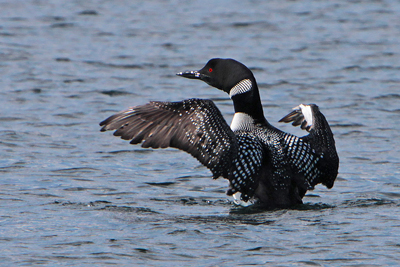
Many people are fascinated by these amazing animals swimming about on Squam Lakes. Sharing the waters with other birds like the Blue Heron, the Common Loon stands out with its recognizable black and white plumage. The Common Loon is one of five species of loon. Both Squam Lakes are blessed to have this bird call it home. Loons claim territory on the shorelines around the lakes, spending the majority of their lives in the air and swimming in the water. The Common Loon only comes ashore to lay eggs in early summer, but there is great danger to doing this. Eggs may become prey to animals like raccoons and turtles. Both parents stand guard on the nest and incubate the eggs as they try to prevent the loss of one of their precious chicks.

From the fall of 2004 to the spring of 2005, 44% of the loon population on Squam Lakes was lost. Out of the 16 pairs that flew south in 2004, only 9 pairs returned to lay eggs in 2005. More recently in 2014 there were 12 pairs of loons creating homes on the beautiful shores of Squam, and this summer 13 pairs were spotted. What caused such a dramatic drop from 2004 to 2005? Loons face many stresses in the wild even here at Squam. In 2001 with the reopening of the public boat launch, it was noted that human recreational use of the lake went up. Such acts can disturb nesting loons. Other stresses such as lead fishing tackle, extreme temperatures, and a high number of contaminants also have a negative impact on loons.

Here in New Hampshire the Common Loon is considered a threatened species. What exactly does this mean? A threatened species is characterized by a dramatic change in population – based on how many individuals are able to breed and the number of offspring that survive. The Loon is characterized as critical, meaning it is unable to sustain its population by itself in the wild in New Hampshire.

Squam Lakes Natural Science Center is concerned about this, so we have united with the Loon Preservation Committee (LPC) to offer Loon Cruises twice a week each summer. These cruises take visitors around Squam Lake. Participants see some artificial loon nest platforms made and monitored by the LPC. They also hear about conservation ecology for the Common Loon. The boat trip lasts for 90-minutes. It is a great way to spend an afternoon while learning about one of New Hampshire’s most recognizable birds!

Learn more about our Loon Cruises. 

February 3, 2014

Horned Grebe


You never know what you might find on your doorstep.

A few weeks ago we got a call from someone at the Loon Mountain Ski area in Lincoln, reporting a strange bird sitting on the steps of the ski lodge. The person thought it was a Grebe. They brought it to the Science Center and sure enough it was a Red-necked Grebe. This close relative of the Loon breeds in the arctic and usually spends the winter months on the ocean (or on unfrozen sections of large inland lakes). Like the Loon, they are clumsy on land -- having legs positioned far back on their bodies and need a “water runway” to get airborne. They are perfectly adapted for a water-based lifestyle, diving under water to catch small fish and breeding on freshwater lakes and ponds. Loons and Grebes have both been recorded grounding themselves when they inadvertently land on open areas of tarmac which from the air they mistake for open water. Once on the ground they are unable to get airborne again.

When the Red-necked Grebe was dropped off, our animal care staff quickly assessed that it was uninjured and we quickly decided that the best course for this bird was to get it to open water (the ocean) as quickly as possible. Director Iain MacLeod put the call out to the New Hampshire birding community and an old friend of Iain’s – Dick Hughes from Exeter – came to the rescue. He and his daughter drove up to Holderness, picked up the carrier with the Grebe and headed for Seabrook Harbor where the bird was successfully released.

Imagine our amazement when the next week, we got a call from a resident in Plymouth saying he had a “baby loon” on their doorstep. Once the bird arrived here, a quick look determined that it was a Horned Grebe – a slightly smaller close cousin of the Red-necked Grebe. Iain put out the call and two more long-time birding friends of Iain’s – Sylvia Hartmann and Jane Hills came to the rescue. They drove up from Manchester and ferried the Grebe down to Seabrook for a successful release.
 
So . .  where might these Grebes be coming from. Iain’s best guess is that they are heading for the ocean after losing open water on the Great Lakes or Lake Champlain. Perhaps this very cold winter has frozen over sections of these lakes that haven’t frozen in recent winter. These Grebes were the lucky ones that were able to escape the ice and after mistakenly landing on solid ground were found and rescued. Hopefully these two little lost visitors have a second chance – thanks to some kind helpers.

June 3, 2013

Protecting New Hampshire's Loons


Courtesy of the Loon Preservation Committee:

The NH House of Representatives passed Senate Bill 89 earlier this month by a vote of 225-142 - a convincing margin. SB 89 will protect our state's loon population by banning the sale and freshwater use of toxic lead fishing sinkers and jigs weighing one ounce or less--still the largest known cause of New Hampshire adult loon mortality.

We hope that the Governor will sign SB 89 into law soon, and we will update you as further details become available. Since the bill was slightly amended by the House (extending the phase-in period from two years to three), it will return to the Senate briefly before reaching the Governor. The Senate must concur with the House's change which is expected. This has been a great team effort.

The Loon Preservation Committee (LPC), NH Lakes Association (NH LAKES), and NH Audubon have worked closely together in support of SB 89.

November 6, 2012

Squam Loon Update

We wanted to pass along the final loon report from Tiffany Grade, Squam Lake Project Biologist at Loon Preservation Committee.
As we wrap up the field season on the Squam Lakes, I wanted to send you all a quick update on the loons. Happily, the two chicks on Squam Lake and the one chick from Little Squam Lake all survived throughout the Fall and seem to be thriving! Many of the adults have left the Lakes to spend the winter off the coast of New England, but at least one of the parents still remains with each of the chicks. The chicks, of course, are taking advantage of this and continuing to beg for food from their parents, even though they are capable of feeding themselves at this point. Their free meals won't last much longer, however, as the parents will soon head for the ocean too. The chicks will remain on the Lakes for approximately one more month, continuing to feed and strengthen their flight muscles for their own trips to the coast.

Many of the free meals I have seen the chicks receiving in recent months have been crayfish, which both adult loons and chicks feed on in addition to fish. I, too, have been busy this Fall collecting crayfish, as well as water samples from Squam Lake. As part of the Loon Preservation Committee's Squam Lake Loon Initiative, we will be testing these samples for contaminants to better understand the distribution of contaminants around the lake and their possible impacts on loons.

Thank you for your interest in the loons of the Squam Lakes! I invite you to visit our updated webpage on the threat of lead fishing tackle to loons (http://www.loon.org/ingested-lead-tackle.php). Please do not hesitate to contact me with any questions about loons or the Squam Lake Loon Initiative, LPC's effort to restore a healthy population of loons to Squam Lake (http://www.loon.org/squam-lake-study.php).
I wish you all a very Happy Autumn and look forward to being in touch with you when our loons return next spring!